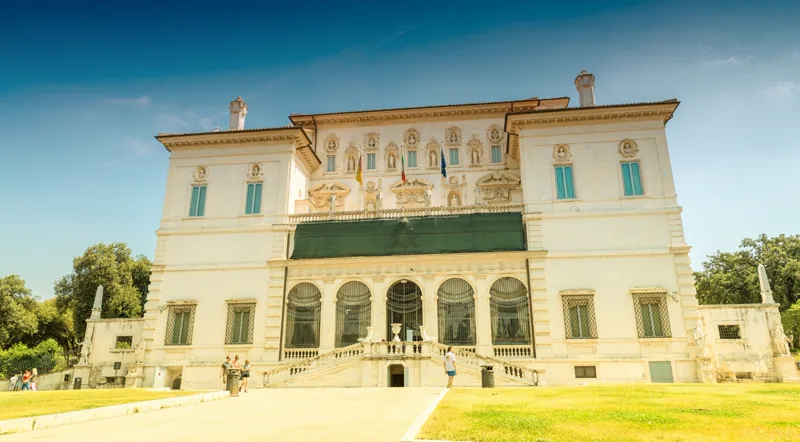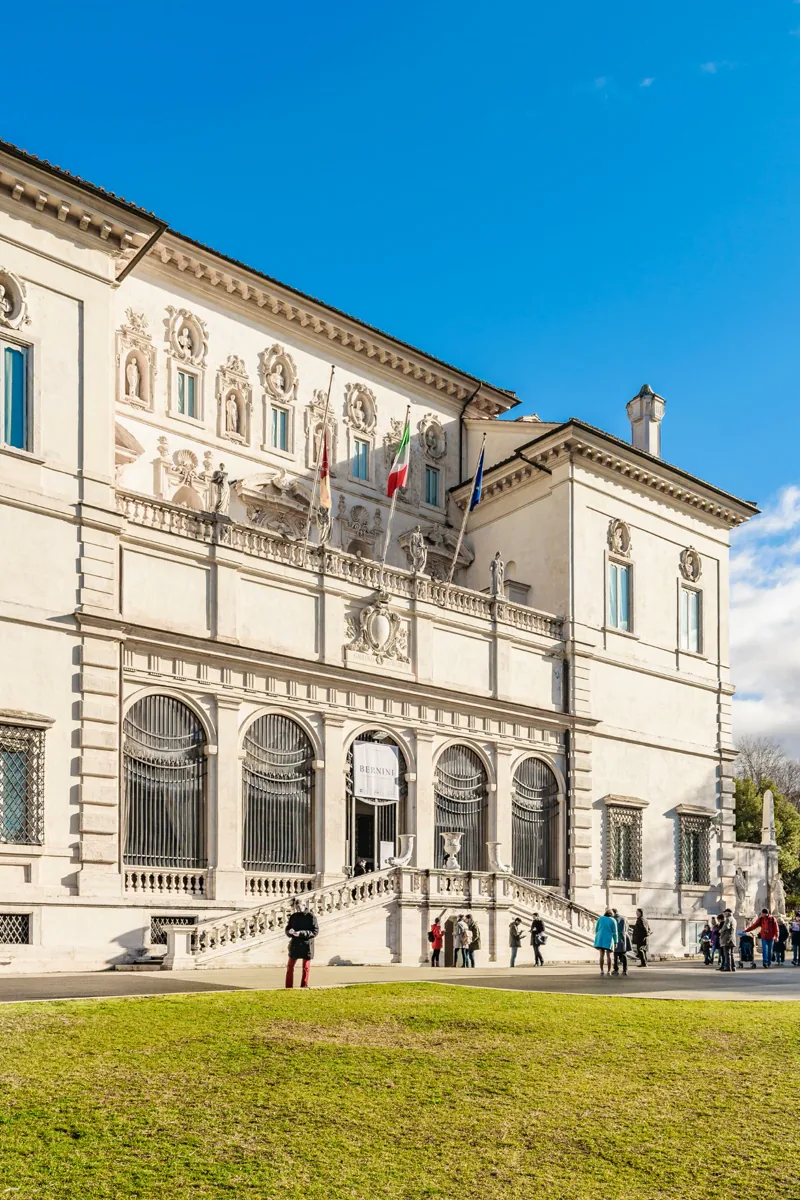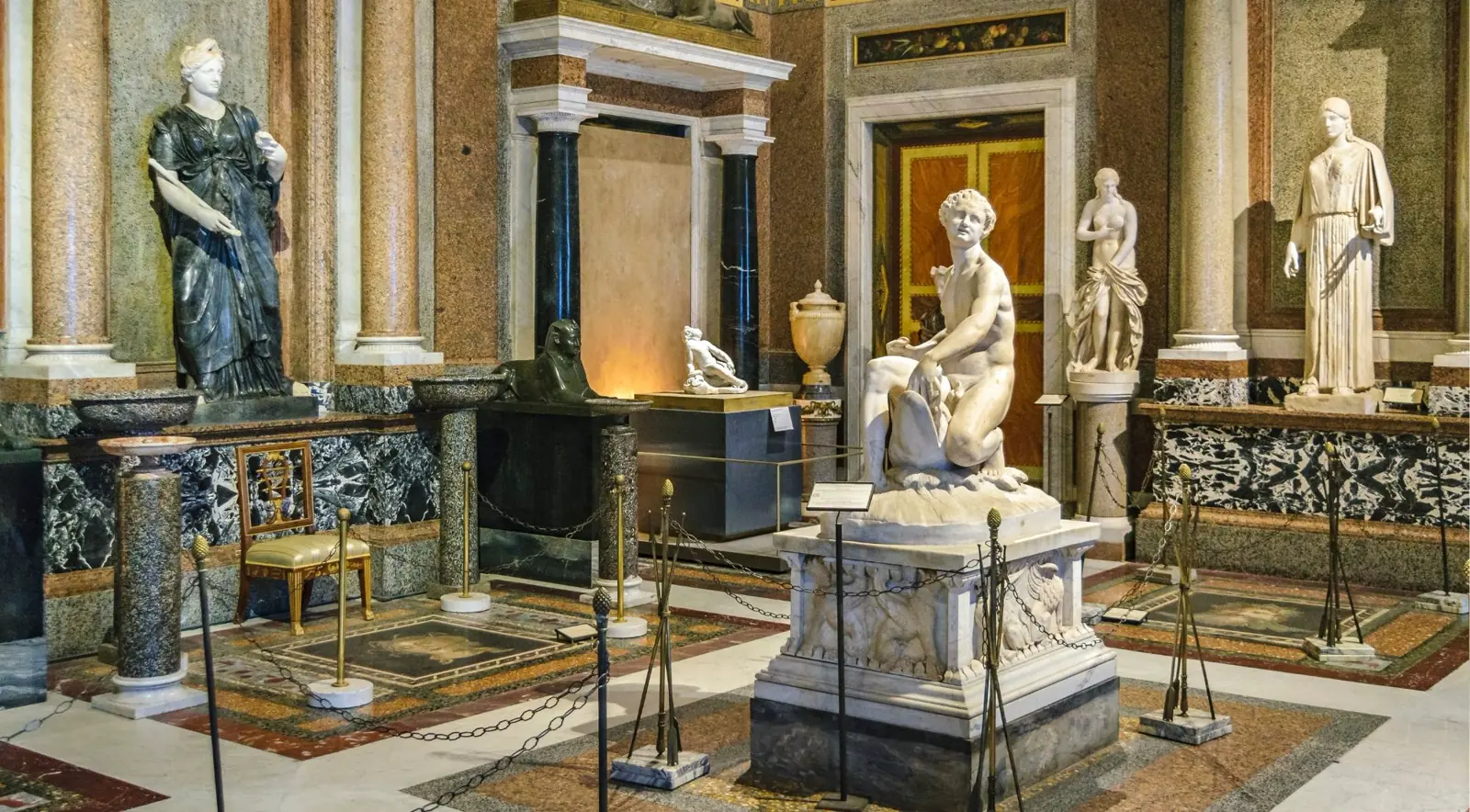
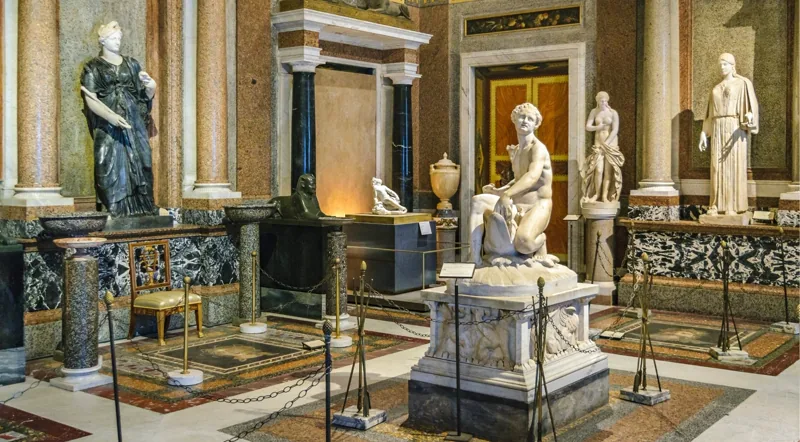
Pauline Borghese Bonaparte as Venus Victrix (1804–1808), in Carrara marble by Antonio Canova, is the Neoclassical masterpiece of the Borghese Gallery and the only Canova sculpture in the permanent collection, displayed in Room I (the Pauline Room) on the ground floor. Commissioned by Prince Camillo Borghese, it portrays Napoleon's sister as the goddess who won the Judgement of Paris; it is famous for the anecdotes about the "nude" pose, for the mechanism that made the statue revolve, and for the finish that softened the marble by candlelight. Canova's other great Roman works — the Perseus and the boxers in the Vatican Museums, the monuments to Clement XIV and Clement XIII, the Stuart Cenotaph — are elsewhere: to see the Pauline you need a booked Borghese Gallery ticket, with visits in two-hour time slots.
Who Antonio Canova was
Antonio Canova was born at Possagno (Treviso) on 1 November 1757 and died in Venice on 13 October 1822. He is regarded as the greatest exponent of Neoclassicism in sculpture, nicknamed "the new Phidias". The son of a stonecutter, orphaned of his father as a child, he was set on the path to art by his grandfather Pasino, a stonemason. He served his apprenticeship in Venice, attending the Accademia del Nudo and carving early works such as Orpheus and Eurydice and Daedalus and Icarus (1779).
In 1779 he travelled to Rome and settled there from 1781; the city remained his point of reference for the rest of his life. In contact with the Neoclassical theories of Winckelmann and Mengs, and after visits to Pompeii and Herculaneum, he developed an art founded on the ideal of beauty, on grace, and on the "finish" of highly polished marble surfaces. In Rome he produced masterpieces such as Theseus and the Minotaur (1781–1783), Cupid and Psyche, the Penitent Magdalene and the great funerary monuments.
Canova had prestigious patrons across Europe: the papal court, the Habsburgs, the Bourbons, the Venetian, Roman and Russian nobility, and the Bonaparte family. He portrayed the Napoleonic circle and produced works such as Napoleon as Mars the Peacemaker and the Pauline Borghese. In 1802 he was appointed Inspector General of Antiquities and Fine Arts of the Papal State, a role tied to his position at the Accademia di San Luca. In 1815, after Napoleon's fall, Pope Pius VII sent him to Paris to recover the Italian works of art taken by the French: through skilful diplomacy he brought most of the masterpieces home. In recognition the pope granted him the title of Marquess of Ischia with an annuity of three thousand scudi, which Canova put towards supporting the art academies. In his final years he had the Tempio Canoviano built at Possagno, where he is buried.
Other experiences in Rome worth adding
Visitors who come to the Borghese Gallery for Canova usually build a Neoclassical and Baroque itinerary around it: the Vatican Museums, home to the Perseus Triumphant and the boxers; St Peter's Basilica with the monument to Clement XIII and the Stuart Cenotaph; the Basilica dei Santi Apostoli; and, a few steps from the museum, the gardens of Villa Borghese and the Galleria Nazionale d'Arte Moderna. Many pair the museum with a guided tour on Bernini and Caravaggio or a walk up to the Pincio Terrace.
Pauline Borghese as Venus Victrix: the gallery's masterpiece
The commission
Camillo Borghese had married Pauline Bonaparte, Napoleon's sister, in Paris in 1803. Pauline, born in Ajaccio in 1780, was 23 and already the widow of General Leclerc. Having moved to Rome, to Palazzo Borghese, she devoted herself to society life. Although the marriage was not a happy one, Camillo summoned the most illustrious artist of the moment to portray his wife, commissioning the work in 1804. According to the official record of the Borghese Gallery collection, Canova "is recorded as paid 6000 scudi on 15 May 1808 (Faldi 1954; Pupillo 2019)".
The subject
Pauline is shown as Venus Victrix of the Judgement of Paris: in her left hand she holds the golden apple, the symbol of her victory in beauty over her rivals Juno and Minerva. In the myth, the Trojan prince Paris had to award the apple "to the fairest" among Hera, Athena and Aphrodite, and chose the last. By likening Pauline to Venus, Canova celebrated the princess's beauty and with it the triumph of the Bonapartes. The story goes that the artist first suggested portraying Pauline as Diana the huntress, but that the princess refused, saying nobody would ever believe her a virgin.
The technical data
Carrara marble, inventory number LIV, height 92 cm, 160 cm including the couch, dated 1804–1808. The figure reclines languidly on an agrippina (a couch with a single armrest, the Empire-style triclinium-chaise longue), the torso nude, the lower body wrapped in light drapery. The idealised face raises her to a divine plane, while details such as the bracelet at her wrist and the rosy patina of the flesh bring her back to a semblance of life.
Canova's technique
Canova ran his workshop reserving for himself the conception and "the last hand": the patient polishing, with ever finer abrasives, that produced the effect of "real flesh". Roughing out the marble was left to assistants, working from "points" fixed on the plaster model. On the Pauline, Canova applied as a finish the acqua di rota: according to the museum's official record this was "the water that was run over the grindstone to stop the sharpening irons overheating, which gave the surface a rosy sheen (Cicognara 1824)". The effect was heightened when the statue was seen by candlelight.
The rendering of the mattress is extraordinary — it seems to sink under the goddess's weight — and it is an avowed homage to the mattress Bernini had carved for the Borghese Hermaphrodite, sold to Napoleon in those very years.
The rotating mechanism
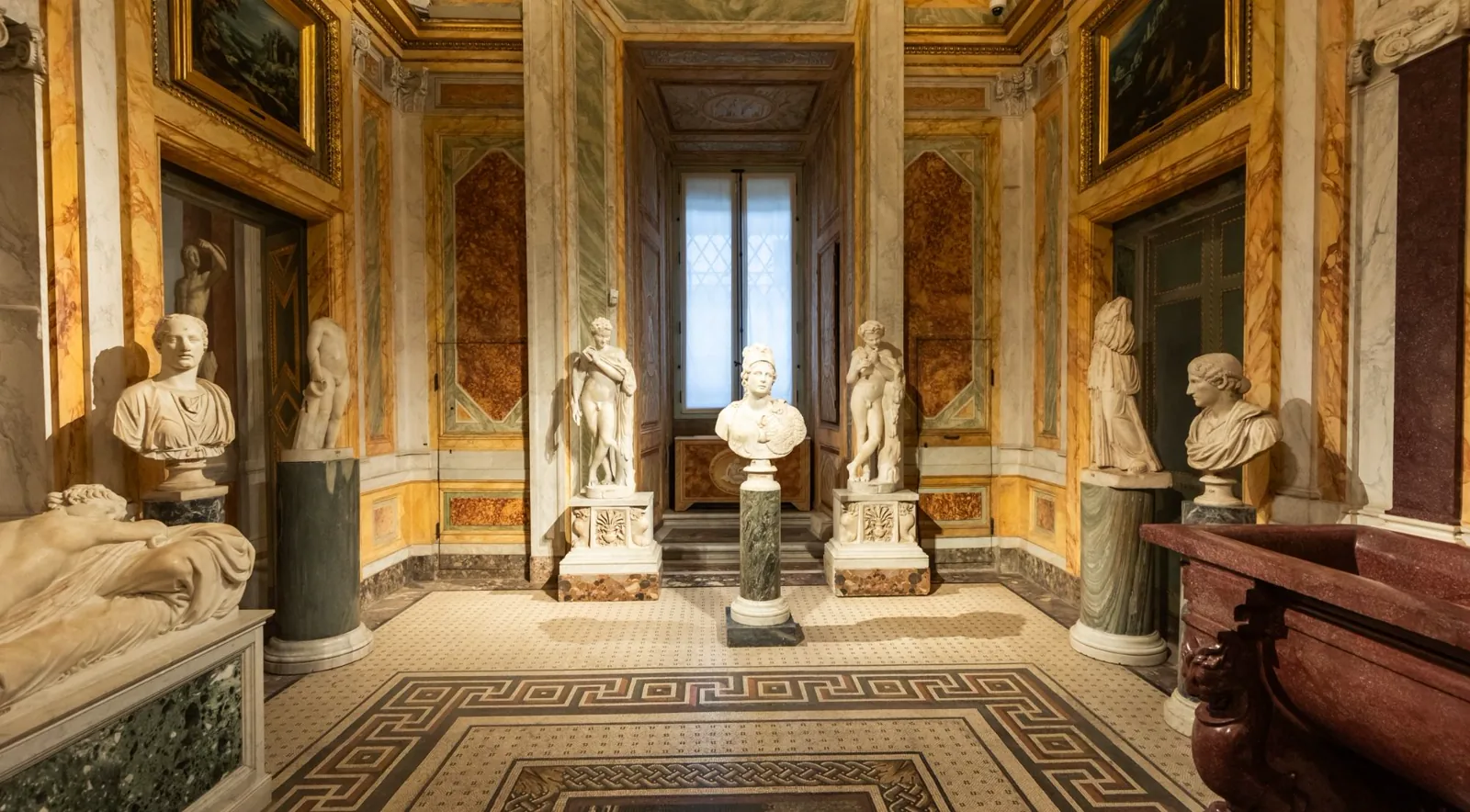
Hidden beneath the agrippina is an ingenious mechanism turning on a central axis, made in Turin, which allowed the sculpture to revolve and be seen through a full 360°, revealing constantly changing effects of light. The mechanism was restored to working order during the 1997 restoration. In 1953 two lion's paws were added to the couch.
The anecdotes
The work caused a stir for its sensuality and for the nudity of a real, living person. Gossip flourished about whether Pauline had posed undressed; to anyone who asked, tradition has it, the princess replied with irony: «But the room was well heated!» or «Every veil may fall before Canova». The sources do not allow us to establish with certainty whether she really posed nude: the debate is open and these stories should be treated as legend.
What became of the statue
Delivered in 1808, the statue was moved in 1809 to Turin (Palazzo Chiablese), where Camillo was governor of the departments beyond the Alps. It returned to Rome by sea in 1814 and was displayed at Palazzo Borghese in Campo Marzio, where it could be admired even at night by torchlight. In 1820 Camillo decided to shut it in a crate, to put a stop to the trade in paid admissions run by his servants and to avoid damaging relations with the papal court.
Pauline herself, in a letter of 22 January 1818, had asked her husband to stop showing it:
«Camillo, I should like to ask you a favour… I know that you sometimes allow people to see my marble statue. I should be glad if this were to stop, because the nudity of the sculpture borders on indecency. It was created for your pleasure, that is no longer so, and it is right that it should remain hidden from the eyes of others».
In 1838 the sculpture arrived at the Villa Borghese (the Room of Helen and Paris) and in 1889 it was placed where it stands today, Room I on the ground floor, in keeping with the ceiling paintings by Domenico De Angelis showing the Stories of Venus and Aeneas. It was bought by the Italian state in 1902.
Reading the sculpture
The Pauline fuses portrait and ideal goddess: the Neoclassical idealisation of the face sits alongside an almost painterly naturalism of flesh and veils. The composition balances the horizontal and vertical lines of the couch against the diagonals of the body, and the slightly turned head invites a three-quarter view. The pose recalls the classical repertoire — Etruscan and Roman figures on sarcophagi — and the Venetian tradition of the sixteenth century, the Venuses of Titian and the Danaë of Correggio, with which the work was in notional competition inside the villa itself. It belongs to what is called the "graceful" strand of Canova's output. The original plaster is at the Gipsoteca di Possagno, the preparatory drawings at the Museo Civico di Bassano.
The Pauline is the only work by Canova in the Borghese Gallery's permanent collection. The fifty-plus works shown for the exhibition "Canova e la Venere Vincitrice" (Borghese Gallery, 2007–2008, curated by Anna Coliva and Fernando Mazzocca) were temporary loans from major museums around the world, and are not part of the collection.
Canova's other great works in Rome and the Vatican
The Pauline is the only Canova sculpture in the Borghese Gallery's permanent collection. But Rome holds other masterpieces by the artist:
- Perseus Triumphant in the Vatican Museums (Museo Pio-Clementino, Cortile Ottagono): conceived around 1797 and carved in marble between the end of 1800 and the first months of 1801, it was placed on the pedestal of the Apollo Belvedere.
- The two boxers, Creugas and Damoxenos, in the Vatican Museums: modelled in the 1790s and bought by Pius VII in 1801.
- Funerary monument to Clement XIV (1783–1787) in the Basilica dei Santi Apostoli: on its unveiling it was hailed as the rebirth of Greek sculpture.
- Funerary monument to Clement XIII (1783–1792) in St Peter's Basilica: with the pontiff kneeling in prayer and the celebrated lions at the base.
- Cenotaph of the last Stuarts (commissioned in 1810 by Mgr Angelo Cesarini, erected in 1819) in St Peter's Basilica: a truncated-obelisk structure with the two nude angels that caused controversy.
- The Galleria Nazionale d'Arte Moderna holds Hercules and Lichas.
The Vatican Museums are the city's second Canova address, and like the Borghese Gallery they need a ticket bought in advance: without one the queue can last hours.
Our pick on GetYourGuide: skip-the-line ticket for the Vatican Museums and Sistine Chapel — rated 4.5 from over 155,000 reviews.
Seeing the Pauline with an art historian
Room I is the first on the route, and a guide earns their keep on what the eye alone misses: the acqua di rota finish, the mattress that quotes Bernini, the dialogue with the De Angelis ceiling directly above the statue's head. In a strictly timed two hours, having someone point those out changes the visit.
Small-group guided tour with skip-the-line entry
A licensed art historian opens the visit at the Pauline in Room I, then moves on to the four Berninis and the Caravaggio room, at the pace of the two-hour slot. It is the best-rated tour on this site: 4.7 from 2,700+ reviews.
Canova's masterpieces outside Rome
Many famous works are not in Rome. It is worth knowing before you travel, so you do not go looking in the Borghese Gallery for something that is in Paris or St Petersburg:
- Cupid and Psyche (1788–1793): at the Louvre in Paris; a second version (Cupid and Psyche standing) is at the Hermitage in St Petersburg.
- The Three Graces: the first version (1812–1816) at the Hermitage, the second (1814–1817) shared between the Victoria and Albert Museum in London and the National Galleries of Scotland.
- Theseus and the Minotaur (1781–1783): at the Victoria and Albert Museum.
- Hebe: in several versions (Berlin, Forlì, Chatsworth).
- Funerary monument to Maria Christina of Austria (1798–1805): in the Augustinian church (Augustinerkirche) in Vienna, with its celebrated pyramid structure.
- Napoleon as Mars the Peacemaker (1803–1806): the marble at Apsley House in London, the bronze version at the Brera in Milan.
- Penitent Magdalene: in Genoa (Palazzo Bianco).
- Daedalus and Icarus: at the Museo Correr in Venice.
- The Gipsoteca di Possagno holds the original plasters of his entire output, now dispersed among museums worldwide.
How to see it: visiting and tickets
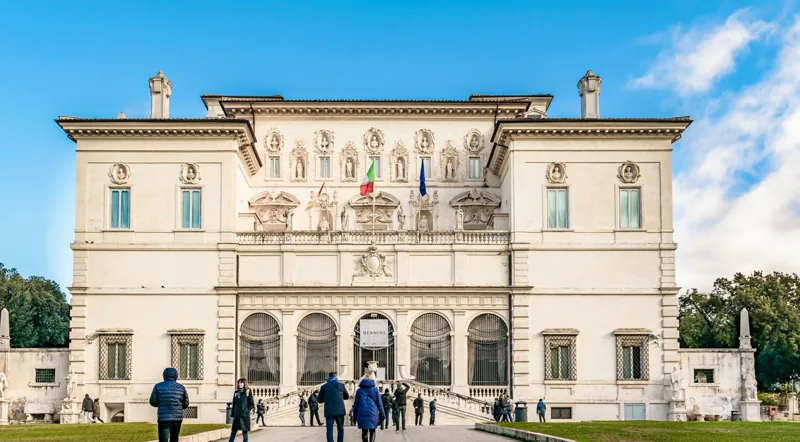
The Pauline is in the first room of the Borghese Gallery. To see it you need a booked ticket: booking is compulsory for every ticket category, free entries included. The museum is open Tuesday to Sunday, 9:00 to 19:00, with last entry at 17:45; it is closed on Mondays. Visits run in two-hour time slots, with capacity limited to 180 people per slot.
| Ticket | Entry | Booking fee | Total |
|---|---|---|---|
| Full | €16.00 | €2.00 | €18.00 |
| 17:45 evening slot | €11.00 | €2.00 | €13.00 |
According to the official site (2026 data) the full ticket costs €16.00 plus €2.00 booking fee, €18.00 in total, while the 17:45 evening slot costs €11.00 plus €2.00. Prices can rise during temporary exhibitions and should always be checked on the official site. Book well ahead, because places sell out fast. Full detail on fares, reductions and official channels is in our guide to Borghese Gallery tickets.
Skip-the-line ticket with audioguide
If you are coming mainly for the Pauline and want to stand in front of her as long as you like, this is the right option: a guaranteed slot and an audioguide, with no guide in tow. Rated 4.6 from 2,700+ reviews.
Building a Canova itinerary
- If you are visiting Rome: book the Borghese Gallery ticket weeks ahead through the official channel, choosing a time slot. Room I with the Pauline is the first you come to on the ground floor.
- To complete a Canova itinerary in Rome: pair the visit with the Vatican Museums (Perseus and the boxers) and the basilicas of St Peter's (Clement XIII, the Stuart Cenotaph) and Santi Apostoli (Clement XIV).
- To go deeper: consult the official record on the Borghese Gallery collection site and, for the plasters and drawings, the Gipsoteca di Possagno and the Museo Civico di Bassano.
- Thresholds that change the advice: always check hours and prices on the official site before visiting, because they vary with temporary exhibitions; on free-entry days (the first Sunday of the month) booking remains compulsory and places go even faster.
The ground floor continues with Bernini's four groups and closes with Room VIII and the six Caravaggios; the story of how all of this ended up in a single villa is told in our guide to Scipione Borghese and the history of the collection.
The anecdotes about Pauline's nude pose and the retorts attributed to her are traditions that cannot be documented with certainty and should be read as legend; the 1818 letter, too, circulates in translation, quoted by secondary sources. Some sources date the work 1805–1808 rather than 1804–1808: the Borghese Gallery's official dating is 1804–1808 (commissioned 1804, paid May 1808). On the placement of the Stuart Cenotaph in St Peter's the secondary sources disagree (left or right nave); the most authoritative — Italian Wikipedia and the Museo di Roma — give the left nave. For the Vatican Perseus, "1797" refers to the conception and "1800–1801" to the execution in marble: not a contradiction but a distinction between design and carving. Prices and hours are indicative (2026 data) and should be checked on the official site before visiting.
Frequently asked questions
Answers to the questions that come up most about Canova and the Pauline Borghese.
Where is Canova's Pauline Borghese?
In Room I of the Borghese Gallery, also known as the Pauline Room, on the ground floor: it is the first room you come to on the visitor route.
How many works by Canova are in the Borghese Gallery?
Only one in the permanent collection: Pauline Borghese Bonaparte as Venus Victrix. The fifty-plus works shown for the 2007–2008 exhibition Canova e la Venere Vincitrice were temporary loans from major museums around the world.
What is the date of the Pauline Borghese and how big is it?
It is dated 1804–1808: the commission is from 1804 and Canova is recorded as paid 6000 scudi on 15 May 1808. It is Carrara marble and measures 92 cm high, 160 cm including the couch. Inventory number LIV.
Why is Pauline shown as Venus Victrix?
Because she holds the golden apple of the Judgement of Paris, the prize awarded to the most beautiful of Juno, Minerva and Venus. By likening Pauline to Venus, Canova celebrated both the princess's beauty and the triumph of the Bonapartes.
Did Pauline really pose nude?
It cannot be established. The sources do not allow a definite answer, and the retorts attributed to her — «But the room was well heated!» and «Every veil may fall before Canova» — are undocumented traditions and should be treated as legend.
Is it true that the statue used to revolve?
Yes. Hidden beneath the couch is a mechanism on a central axis, made in Turin, which allowed the sculpture to turn a full 360° and reveal constantly changing play of light. It was restored to working order during the 1997 restoration.
What is the acqua di rota used on the Pauline?
It is the finish Canova applied to the marble: according to the museum's official record, «the water that was run over the grindstone to stop the sharpening irons overheating, which gave the surface a rosy sheen» (Cicognara 1824). The effect was heightened by candlelight.
Where can you see Canova's other works in Rome?
The Perseus Triumphant and the boxers Creugas and Damoxenos are in the Vatican Museums, the monument to Clement XIV in the Basilica dei Santi Apostoli, the monument to Clement XIII and the Stuart Cenotaph in St Peter's, and Hercules and Lichas at the Galleria Nazionale d'Arte Moderna.
Do you need to book to see the Pauline?
Yes. Booking is compulsory for every ticket category, free entries included. Visits run in two-hour time slots with capacity limited to 180 people per slot, and places sell out quickly.
How much is a ticket to see the Pauline?
According to the official site (2026 data) the full ticket costs €16.00 plus €2.00 booking fee, €18.00 in total; the 17:45 evening slot costs €11.00 plus €2.00. Prices can rise during temporary exhibitions and should always be checked on the official site.