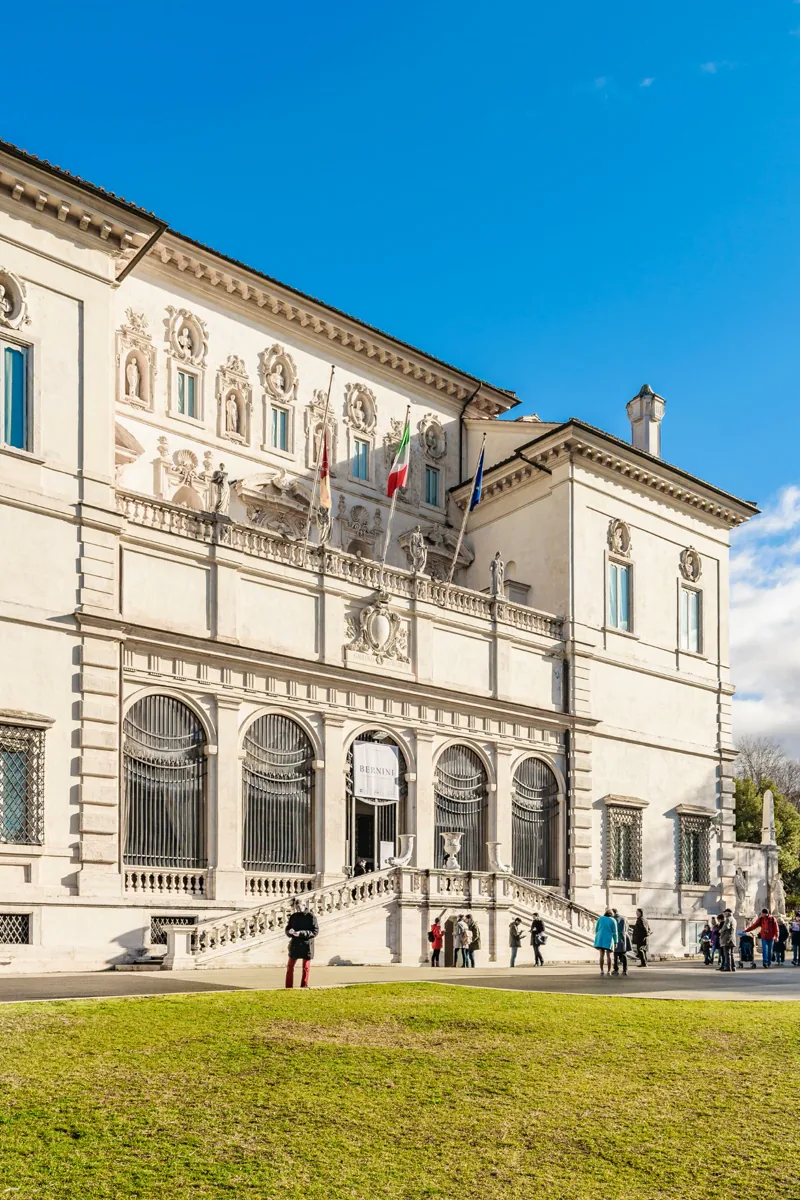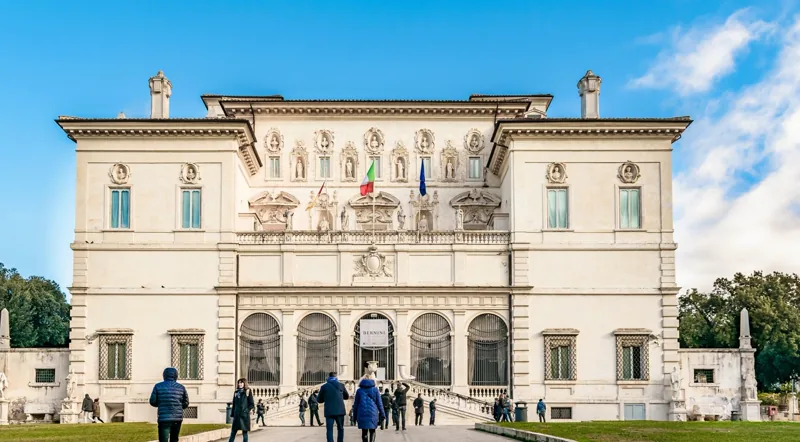
The Borghese Gallery can only be visited by booking, in two-hour slots. The ground floor holds the sculpture — Bernini's four masterpieces, Canova's Pauline Borghese and, as the one painted exception, the six Caravaggios; the first floor holds the picture gallery, with Raphael, Titian and Correggio. If you are short of time, aim for about ten works: Apollo and Daphne, David, The Rape of Proserpina and Aeneas and Anchises by Bernini; Canova's Pauline; the six Caravaggios; Raphael's Deposition and Lady with a Unicorn; Titian's Sacred and Profane Love; Correggio's Danaë. The single most famous work is Bernini's Apollo and Daphne, in Room III. Allow roughly 50-60 minutes for the ground floor and the same again for the picture gallery.
How the visit works (and why you need a plan)
The Borghese Gallery is not a museum like the others. Access is regulated in two-hour visiting slots, with compulsory booking for every ticket type, free tickets included; each slot admits a maximum of 180 people. When the slot ends, leaving is compulsory. That constraint — a consequence of the historic building itself — makes it essential to arrive with a precise plan of what to see.
The museum occupies 20 frescoed rooms which, together with the portico and the entrance hall, make up the spaces open to the public. The collection, begun by Cardinal Scipione Borghese at the start of the 17th century, spans art from the 15th to the 19th century: ancient sculpture, mosaics and above all the masterpieces of Bernini, Caravaggio, Raphael, Titian, Correggio and Canova. A further 260-plus paintings are held in the Depositories, which can be visited separately by appointment.
The layout is simple: the ground floor is devoted to sculpture — with the surprising exception of the six Caravaggios, which close the ground-floor route in Room VIII — while the first floor holds the paintings, the picture gallery. The advice is to start on the ground floor, following the order of the rooms, and go up to the picture gallery afterwards. Allow roughly 50-60 minutes per floor, keeping a margin at the end.
Other experiences in Rome worth your time
Two hours at the Borghese Gallery leaves the rest of the day open, and the museum is surrounded by everything else: the Villa Borghese park with its lake and the Temple of Aesculapius, the Pincio Terrace overlooking Piazza del Popolo, and a short walk away the Cerasi Chapel in Santa Maria del Popolo with two more Caravaggios. Anyone wanting to stay with the Baroque continues on a Bernini in Rome itinerary — Piazza Navona, the Quirinale, St Peter's — or with the Museo Nazionale Romano and the Galleria Doria Pamphilj.
Ground floor: the sculpture
Entrance hall (Salone di Mariano Rossi)
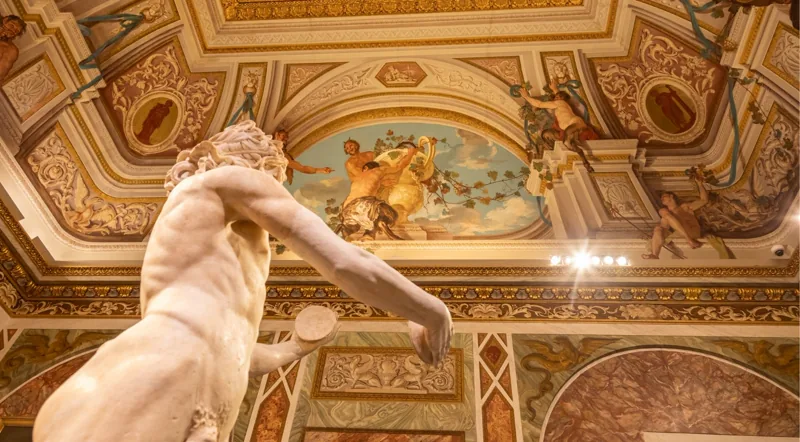
Step through the door and look up: the vault is dominated by the enormous fresco by Mariano Rossi, painted between 1775 and 1779, celebrating the glory of Roman civilisation with Romulus at its centre, received on Olympus by Jupiter to secure Furius Camillus's victory over Brennus, king of the Gauls. It is a triumph of perspective and illusionistic ceiling painting.
Set into the floor is the Gladiator Mosaic, datable to roughly 320-330 AD and unearthed in 1834 on the Borghese estate at Torrenova, on the Via Casilina: it shows combat scenes with the gladiators' names and the «Ø» mark denoting the fallen. On the wall facing the entrance is the relief of Marcus Curtius on horseback, made up of an ancient horse (2nd century AD) and a rider carved by Pietro Bernini, Gian Lorenzo's father, in 1618. In the niches above are the busts of the Twelve Caesars by Giovan Battista della Porta; on the ground, the colossal Attacking Satyr (120-140 AD) that inspired Gian Lorenzo Bernini's David.
Room I — Room of the Pauline
Here stands one of the museum's emblems: Pauline Borghese Bonaparte as Venus Victrix by Antonio Canova (1805-1808). Pauline, Napoleon's sister and Camillo Borghese's wife, is portrayed half-nude, reclining on a triclinium, holding the apple of victory — the one Paris awarded to Venus as the fairest of the goddesses. A masterpiece of Neoclassicism, the sculpture originally rested on a mechanism that let it be rotated so it could be admired from every angle. The vault carries the Stories of Venus and Aeneas by Domenico de Angelis (1779). We have given the statue and its story a guide of its own.
Room II — Room of the Sun (Room of the David)
At its centre stands David by Gian Lorenzo Bernini (1623-1624), the only biblical subject among the works carved for Scipione Borghese. Bernini catches the hero at the instant of maximum tension, a moment before he slings the stone at Goliath: the body torqued, the face intent — by contemporary accounts, a self-portrait of the young artist. On the ground lie the armour given by Saul and the lyre ending in an eagle's head, the Borghese heraldic emblem. The room takes its name from the vault fresco, the Fall of Phaethon by Francesco Caccianiga.
Room III — Room of Apollo and Daphne
The Gallery's outright masterpiece and the most celebrated work in the museum: Apollo and Daphne by Bernini. The cardinal bought the block of Carrara marble on 2 August 1622 and settled with the artist, for a total payment of 1,000 scudi, on 24 November 1625: Bernini was twenty-four. The group captures the exact moment the nymph Daphne, pursued by Apollo, turns into a laurel to escape him: her fingers become branches, her hair leaves, her feet roots. The marble seems to transform as you watch.
«Cavalier Bernini, that most famous sculptor who made the statue of the Pope and the Daphne […] who is the Michelangelo of our century […] is a man to drive people out of their minds.»
Fulvio Testi, poet and diplomat, a contemporary of Bernini
A moralising couplet composed by Cardinal Maffeo Barberini, the future Pope Urban VIII, runs along the base. The room also holds works by Dosso Dossi. The full itinerary of Bernini's works is in our guide to Bernini at the Borghese Gallery.
Room IV — Hall of the Emperors
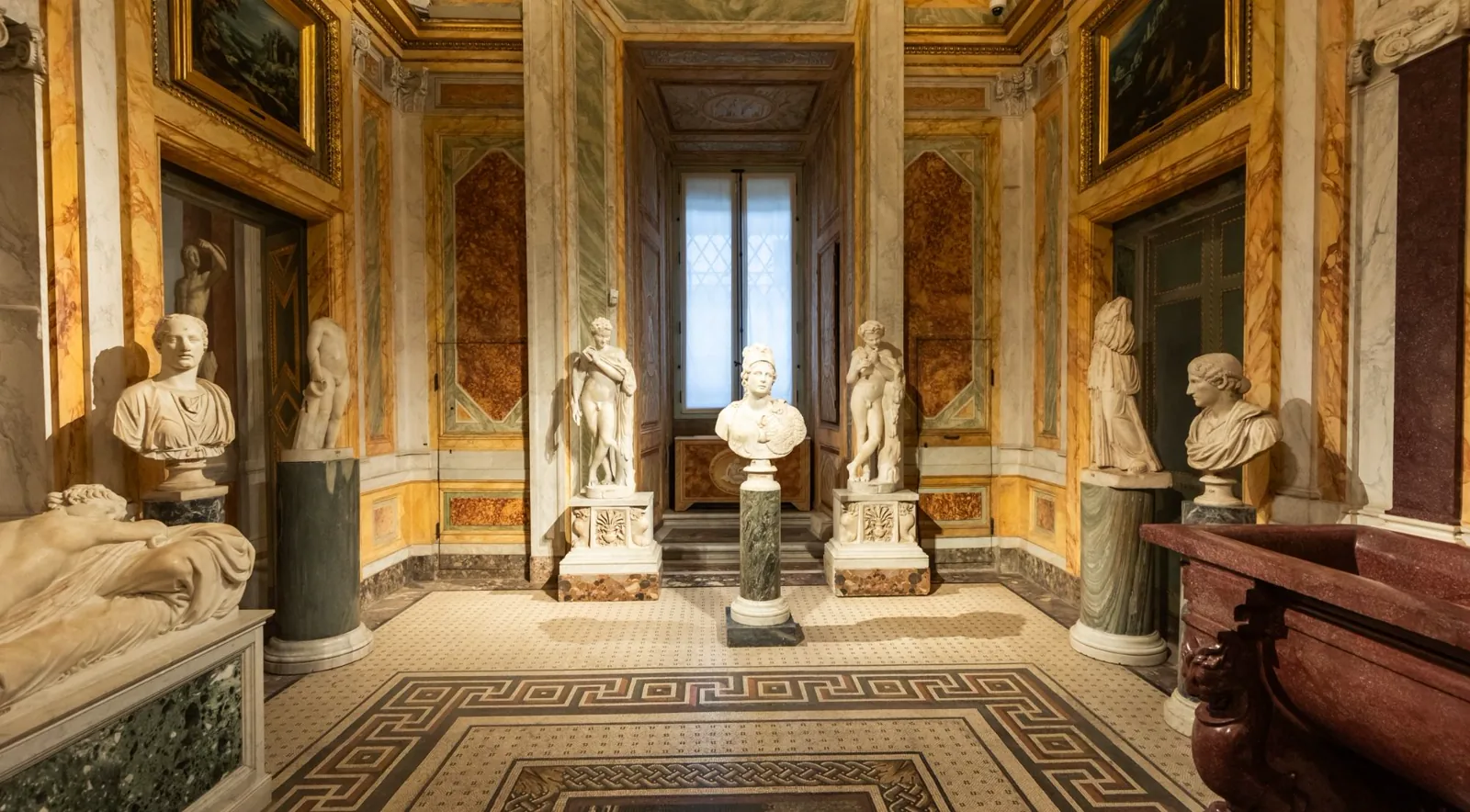
The most sumptuous room on the ground floor, decorated with stucco, marble and frescoes, takes its name from the busts of Roman emperors in porphyry and alabaster set along the walls. At its centre is The Rape of Proserpina by Bernini (1621-1622): Pluto abducting Proserpina, with the celebrated detail of the god's fingers sinking into the flesh of her thigh, as though the marble were soft. Ancient statues fill the niches, among them the Borghese Artemis; also here are Bernini's bronze Neptune with a Dolphin and a version of the Farnese Bull by Antonio Susini.
Room V — Room of the Hermaphrodite
At its centre lies the Sleeping Hermaphrodite, a Roman copy of a Greek original: a body seen from behind that reveals its ambiguous nature only when you walk around it — a theme much loved by Baroque taste. Set into the floor is a Roman mosaic of the 2nd century with fishing scenes. The original Borghese Hermaphrodite, restored by Bernini, was sold to Napoleon in 1807 and is now in the Louvre.
Room VI — Room of Aeneas and Anchises
Two Bernini sculptures. At the centre, Aeneas, Anchises and Ascanius (1619), an early work made when he was barely into his twenties, possibly with his father Pietro's help: it shows the flight from burning Troy and alludes to the three ages of man — old Anchises, adult Aeneas, the child Ascanius. In the same room, according to the official catalogue, stands Truth (Truth Unveiled by Time), carved by Bernini between 1646 and 1652 during a difficult stretch of his career: a nude, smiling young woman holding the disc of the sun, an allegory of the truth that time sooner or later reveals.
Room VII — Egyptian Room
Egyptianising decoration, with antiquities and sculptures such as a Roman-era Satyr on a Dolphin: the room reflects the 18th-century fascination with Egypt and acts as a hinge towards the Caravaggio room.
Room VIII — Room of the Silenus (Room of Caravaggio)
The room that justifies the trip on its own: six canvases by Caravaggio, the largest concentration anywhere, tracing the artist's entire career. They are:
- Boy with a Basket of Fruit (c. 1593-95), from his early Roman years;
- Self-Portrait as Bacchus, the so-called Sick Bacchus (c. 1593-94), a self-portrait with a sickly pallor;
- Saint Jerome (c. 1605-06), the saint shown as a man of learning;
- Madonna of the Palafrenieri (1605-06), the «scandalous» altarpiece rejected by its St Peter's patrons;
- Saint John the Baptist (c. 1609-10);
- David with the Head of Goliath (c. 1609-10), in which Caravaggio painted his own likeness into the giant's severed head.
All six canvases are covered one by one in our guide to the Caravaggios of the Borghese Gallery.
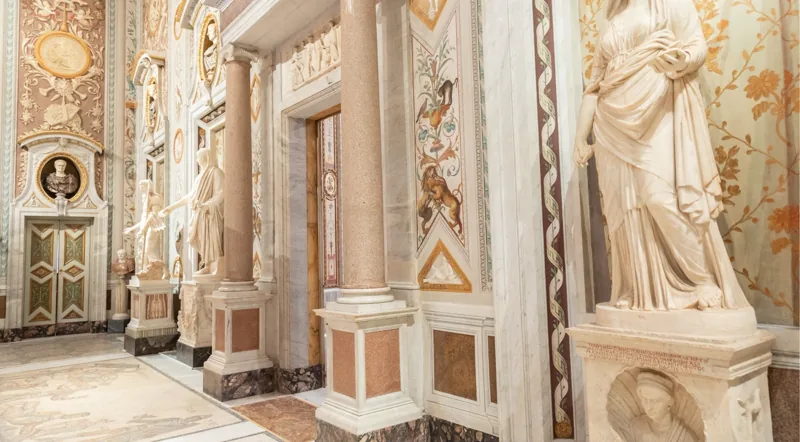
Small-group guided tour with skip-the-line entry
It runs for exactly as long as the slot — two hours — and that is the point: the guide decides what to skip for you, which is the hardest call to make in a museum where the clock runs out. A licensed art historian, in a small group. Rated 4.7 from over 2,700 reviews.
First floor: the picture gallery
You go up to the first floor — reachable by lift — for the picture collection, which gathers paintings from the 15th to the 17th century.
Room IX — Room of Dido
Raphael's room. Dominating it is the Deposition (Baglioni Altarpiece) of 1507, commissioned by Atalanta Baglioni for a church in Perugia and spirited away to Rome on Scipione Borghese's orders: a masterpiece of Raphaelesque compositional balance. Also by Raphael are the Lady with a Unicorn (c. 1505-1506) — a female portrait long converted into a Saint Catherine by later overpainting and returned to its original state in the 1935-36 restoration, which gave back the unicorn as a symbol of chastity — and the Portrait of a Man. The room brings together the masters of the Umbrian and Tuscan Renaissance: Pinturicchio's Crucifixion (1473, the oldest work in the collection), Perugino, Botticelli, the tondi of Fra' Bartolomeo, Andrea del Sarto.
Room X — Room of Hercules
Above the porphyry fireplace hangs Danaë by Correggio (c. 1530-31), part of the celebrated Loves of Jupiter cycle painted for Federico II Gonzaga and bought by Prince Camillo Borghese in Paris in 1827. In the same room is the unmistakable Venus and Cupid Carrying a Honeycomb by Lucas Cranach the Elder (1531), northern and coolly aloof, alongside works by Italian Mannerists such as Parmigianino's Portrait of a Man.
Room XIV — Lanfranco Loggia
A small gallery gathering several Berninis: the two versions of the bust of Cardinal Scipione Borghese (1632) — the second carved in haste after a crack ruined the first — the bust of Pope Paul V, the youthful Goat Amalthea and the terracotta bozzetto for the equestrian monument to Louis XIV.
Note: Bernini's two celebrated painted self-portraits, the youthful and the mature, normally on show in the museum, have exceptionally been lent to the touring exhibition «Tesori nascosti della Galleria Borghese» (Lecce, from 24 July 2026, then Cosenza) and may not be visible in Rome until January 2027.
Room XV — Room of the Dawn
Home to the Last Supper by Jacopo Bassano (1546) and works by Dosso Dossi and Savoldo.
Room XVIII — Room of Jupiter and Antiope
Two important works by Peter Paul Rubens: the Lamentation over the Dead Christ and Susanna and the Elders, evidence of the Fleming's dialogue with Italian art.
Room XIX — Room of Helen and Paris
The Hunt of Diana by Domenichino (1616-1617), taken from the painter by force by Scipione Borghese, who had him imprisoned to get it: Diana and her nymphs in an archery contest drawn from the Aeneid. The same room holds Domenichino's Sibyl, Annibale Carracci's Jupiter and Juno and works by Lanfranco.
Room XX — Room of Psyche
The last of the great rooms, devoted to the Venetian masters of the 15th and 16th centuries. Here hangs Sacred and Profane Love by Titian (c. 1514), a meditation on the duality of earthly and divine love, and Venus Blindfolding Cupid (c. 1560-1565). Do not miss the small, intensely concentrated Portrait of a Man by Antonello da Messina (c. 1475), Giovanni Bellini's Madonna and Child, and works by Giorgione, Veronese and Lorenzo Lotto.
What to see in 2 hours: the must-see shortlist
If time really is short, these are the works not to miss, in the order of the route.
- Pauline Borghese as Venus — Canova (Room I)
- David — Bernini (Room II)
- Apollo and Daphne — Bernini (Room III) — the most famous work
- The Rape of Proserpina — Bernini (Room IV)
- Sleeping Hermaphrodite (Room V)
- Aeneas, Anchises and Ascanius and Truth — Bernini (Room VI)
- The six Caravaggios, above all David with the Head of Goliath and the Madonna of the Palafrenieri (Room VIII)
- Deposition and Lady with a Unicorn — Raphael (Room IX)
- Danaë — Correggio and Venus and Cupid — Cranach (Room X)
- Sacred and Profane Love — Titian (Room XX)
How to manage the time
On the ground floor, linger in Rooms II, III, IV and VIII — Bernini and Caravaggio — and move more briskly past the antiquities. Go up to the picture gallery after about an hour and concentrate on Rooms IX, X and XX. And walk around Bernini's sculptures: they were conceived to be seen from several viewpoints, and looking from one side only means seeing half the work.
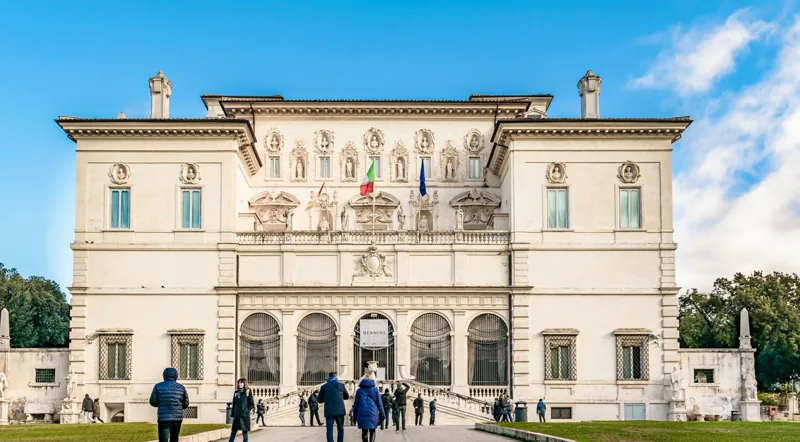
Skip-the-line ticket with audio guide
The right format if you want to work through the shortlist above in your own time, standing in front of Apollo and Daphne for ten minutes if you feel like it. Entry in a booked slot with the audio guide included. Rated 4.6 from over 2,700 reviews.
Practical tips
- Booking is compulsory for everyone, free admission included. The visit lasts two hours and each slot admits up to 180 people. The rules for the free first Sunday are tighter still.
- Opening hours: Tuesday to Sunday, 9.00 to 19.00; closed Mondays. Last entry at 17.45.
- Tickets: the 2026 base fare is €16.00 plus €2.00 in reservation fees, €18.00 in total; the reduced evening slot costs €11.00 + €2.00. Always check current rates on the official site, because the price can rise while a temporary exhibition is running — any difference is paid in cash on collection. The full picture is in our tickets guide.
- Backpacks and large bags are not admitted: only small bags are allowed, maximum 21×15 cm. A cloakroom is available at the entrance.
- Beware unofficial resellers: buy only through the museum's official channels.
- Check before you travel: displays, attributions and locations can change for conservation work, temporary exhibitions or loans. The 180 places per slot frequently sell out weeks or months ahead, especially at weekends and while exhibitions are running.
For more on the individual artists, see our dedicated guides to Bernini, Caravaggio and Canova, the complete guide to the museum and the guide to tickets and opening hours.
The locations given here follow the museum's official catalogue (collezionegalleriaborghese.it): The Rape of Proserpina in Room IV (Hall of the Emperors); Aeneas, Anchises and Ascanius and Truth in Room VI; the two busts of Scipione Borghese and the bust of Paul V in Room XIV (Lanfranco Loggia). Many secondary guides place Truth in the entrance hall: the current official record puts it in Room VI, but displays can vary and it is worth checking on the spot. Some datings differ between sources: Titian's Sacred and Profane Love is dated «1514» in most guides and «1515-1516» in the official digital catalogue; Correggio's Danaë «1530» or «1531»; the Lady with a Unicorn «1505-1506». These are ordinary variations, harmonised here on the official catalogue. On the number of rooms, official sources give 20 rooms plus the portico and entrance hall, while some tourist sources say «22 rooms»: the official figure is used here. On capacity, cultura.gov.it gives 180 people per slot; some older pages say 360. Finally, check for any room closures for survey or conservation work, and for exhibitions in progress, which are integrated into the route and may affect the ticket price.
Frequently asked questions
How many works are there in the Borghese Gallery?
The displayed collection occupies 20 frescoed rooms, plus the portico and the entrance hall; it takes in sculpture, mosaics and paintings from the 15th to the 19th century. A further 260-plus paintings are held in the Depositories, which can be visited separately by appointment.
How long do you need at the Borghese Gallery?
Visits run in two-hour slots, enough time to see the major masterpieces without rushing. Most visitors give roughly 50-60 minutes to the ground floor and the same again to the picture gallery upstairs.
What is the most famous work in the Borghese Gallery?
Gian Lorenzo Bernini's Apollo and Daphne, in Room III, is considered the most celebrated, alongside the same sculptor's The Rape of Proserpina and David, Canova's Pauline Borghese and the six Caravaggios.
Do you need to book the Borghese Gallery?
Yes, booking is compulsory for everyone, including free tickets. Each visiting slot holds a maximum of 180 people and lasts two hours, at the end of which you must leave.
Where are the sculptures and where are the paintings?
The ground floor is given over to sculpture — Bernini's four masterpieces and Canova's Pauline Borghese — with the single painted exception of the six Caravaggios, which close the route in Room VIII. The first floor holds the picture gallery, with Raphael, Titian, Correggio, Rubens and Domenichino.
Which room is Apollo and Daphne in?
Room III, which takes its name from the work. Cardinal Scipione Borghese bought the block of Carrara marble on 2 August 1622 and settled with Bernini, for a total payment of 1,000 scudi, on 24 November 1625: the artist was twenty-four.
How many Caravaggios are in the Borghese Gallery?
Six canvases, the largest concentration anywhere, all in Room VIII: Boy with a Basket of Fruit, the Sick Bacchus, Saint Jerome, Madonna of the Palafrenieri, Saint John the Baptist and David with the Head of Goliath.
Which floor should you start on?
The ground floor, following the order of the rooms, then up to the picture gallery (reachable by lift). Downstairs it pays to linger in Rooms II, III, IV and VIII — Bernini and Caravaggio — and move more briskly past the antiquities.
Is everything always on display?
No. Displays, attributions and locations can change for conservation work, temporary exhibitions or loans. Bernini's two painted self-portraits, for instance, have been lent to the touring exhibition «Tesori nascosti della Galleria Borghese» (Lecce from 24 July 2026, then Cosenza) and may not be on show in Rome until January 2027.
How much is a ticket and what are the opening hours?
The 2026 base fare is €16.00 plus €2.00 in reservation fees, €18.00 in total; the reduced evening slot costs €11.00 + €2.00. The museum opens Tuesday to Sunday from 9.00 to 19.00, closed Mondays, with last entry at 17.45.