The Borghese Gallery grew out of the unbridled passion of a single man: Cardinal Scipione Caffarelli Borghese (1577–1633), nephew of Pope Paul V, who between 1605 and his death assembled one of the largest private art collections ever brought together, using refined taste and unscrupulous methods alike (seizures, blackmail, the imprisonment of artists). The Casino Nobile of the Villa Borghese Pinciana — today the museum — was designed by Flaminio Ponzio and completed by Giovanni Vasanzio between about 1607 and 1633, conceived not as a residence but as a "villa of delights" and a museum in which to display the collection. After the catastrophic sale of the antiquities to Napoleon in 1807 and the transfer of the paintings from the Palazzo Borghese to the villa in 1891, in 1902 the Italian state bought collection, villa and park — "the bargain of the century" — turning Scipione's holdings into the museum you can now visit only by booking.
The man: Scipione Caffarelli Borghese, the cardinal nephew
Scipione was born on 1 September 1577 at Artena (then Montefortino), near Rome, under the name Scipione Caffarelli. He was the son of Francesco Caffarelli, a nobleman in serious financial difficulty, and of Ortensia Borghese, sister of Camillo Borghese, the future Pope Paul V. Precisely because of his father's precarious finances — he lived at Nepi and was only able to return to Rome after 1607 — Scipione's education was paid for entirely by his maternal uncle. The young man studied philosophy at the Jesuits' Collegio Romano and then took a degree in law (in utroque iure) at the University of Perugia.
The turning point came in 1605. After the death of Clement VIII and the very brief pontificate of Leo XI, the conclave elected Camillo Borghese, who took the name Paul V. Barely two months later, on 18 July 1605, the new pope admitted his nephew to the Sacred College, granting him the title of cardinal priest of San Crisogono and — above all — the right to use the Borghese name and arms, in effect adopting him. Scipione was 27.
Following the standard practice of nepotism at the time, the cardinal became the cardinal nephew: he was appointed to the Consulta charged with governing the Papal States and, in September 1605, took over the office of secretary of briefs, gaining control of the Secretariat of State within months. He was, in substance, the de facto head of the papal government and overseer of the Holy See's negotiations. He accumulated an impressive series of offices: governor of Fermo (1606), legate of Avignon (1607), archpriest of the Lateran Basilica (1608) and later of St Peter's (1620), librarian of the Holy Roman Church (1609), first archivist of the Vatican Archive (1612), archbishop of Bologna (1610–1612, without ever residing there), camerlengo of the Sacred College.
Each of these offices carried salaries and revenues. According to the reconstruction by Wolfgang Reinhard (Papstfinanz und Nepotismus unter Paul V, Stuttgart, 1974), his annual income was estimated at around 90,000 scudi in 1609, rising to 140,000 scudi by 1612. With this wealth the cardinal built the family's estate: he bought the holdings of Montefortino (today's Artena) and Olevano Romano from Pier Francesco Colonna, Duke of Zagarolo, for 280,000 scudi and — according to a report of 1672 — concentrated in his own hands around eighty farmsteads in the Roman countryside, besides palaces and villas, often forcing owners to sell at favourable prices.
The sources agree in describing Scipione not as an intellectual but as a man of voracious curiosity and impeccable taste: a bon vivant fond of the table (the fleshy features and double chin are rendered with realism in Bernini's bust), of music, botany, villas and above all art. Contemporaries reported near-public scandals attached to his private life, in particular his attachment to Stefano Pignatelli, whom Scipione raised as far as the purple.
Scipione died in Rome on 2 October 1633, in his Roman palace, a decade after the death of his uncle Paul V (1621). He was buried in the Pauline (or Borghese) Chapel of the Basilica of Santa Maria Maggiore, the sumptuous family chapel built by his uncle.
Other experiences in Rome worth adding
Scipione's Rome can still be visited: beyond the Borghese Gallery and the gardens of Villa Borghese, there is the Pauline Chapel of Santa Maria Maggiore, where the cardinal is buried, and the Palazzo Borghese in Campo Marzio, the "Harpsichord" that housed the family picture collection for two centuries. Many visitors pair the museum with an itinerary on Bernini and the Roman Baroque, a tour devoted to Caravaggio, or a walk up to the Pincio Terrace and Piazza del Popolo.
Scipione the collector: the taste and the unscrupulous methods
With his uncle's rise to the papal throne, Scipione launched at once an intense programme of architectural patronage and a systematic acquisition of works of art. His taste was eclectic but directed: he loved ancient statuary as much as "modern" painting, with a preference for artists who had studied classicism closely. His collections drew in works by Raphael, Titian, Correggio, Domenichino, Guido Reni, Rubens, the Cavalier d'Arpino, Dosso Dossi, Bronzino, Federico Barocci and, of course, Caravaggio and Bernini.
It can fairly be said that with Scipione the modern idea of the collector was born: the collection was no longer merely patronage but a narrative built with a very fine eye — and with a legendary lack of scruple. Several episodes have become emblematic.
The seizure of the Cavalier d'Arpino (1607)
The painter Giuseppe Cesari, known as the Cavalier d'Arpino, was accused by Paul V's agents of illegal possession of firearms (arquebuses). To secure his release he was forced to hand over his rich picture collection — 107 paintings — to the Apostolic Chamber, which Paul V shortly afterwards gave to his nephew Scipione, the presumed architect of the operation. Among those canvases were two early masterpieces by Caravaggio, the Young Sick Bacchus (Self-portrait as Bacchus, inv. 534) and the Boy with a Basket of Fruit, painted in the period when Merisi was working in d'Arpino's own workshop painting "flowers and fruit". The episode is documented by the inventory of the seizure published by A. De Rinaldis in Archivi, III, 1936.
The theft of Raphael's Deposition (1608)
Scipione set his sights on the Baglioni Deposition (or Entombment of Christ), the altarpiece Raphael had painted for the Baglioni chapel in the church of San Francesco al Prato in Perugia. According to the Borghese Gallery's own documentation, the panel was spirited away with the friars' complicity on the night of 18–19 March 1608, reaching Rome probably by the 20th of the same month. Faced with protests from the people of Perugia, Paul V legitimised the appropriation with a motu proprio, declaring the work "the cardinal's private property" and granting two copies in exchange.
The imprisonment of Domenichino (1617)
The Hunt of Diana had been commissioned from the Bolognese painter Domenichino by Cardinal Pietro Aldobrandini, a long-standing rival of the Borghese. When Scipione wanted it for himself and the painter refused to give it up, the cardinal — as the biographer Giovanni Battista Passeri tells it — "sent men to take it from his house by force" and ordered Domenichino imprisoned for several days, until he gave way. The painter received a derisory sum: 40 scudi (150 in all, including the Sibyl).
The purchase of the Sfondrato paintings (1608)
Also in 1608 Scipione obtained, through what was in effect a forced sale, the 71 extraordinary paintings of Cardinal Paolo Emilio Sfondrato, among which the Sacred and Profane Love of Titian is thought to have featured, along with works by Raphael (such as the Portrait of Julius II and the Madonna del velo) later dispersed. To these episodes should be added the purchase (1605) of Caravaggio's Madonna of the Palafrenieri, rejected by the confraternity and bought by Scipione for 100 scudi.
The patronage of Bernini
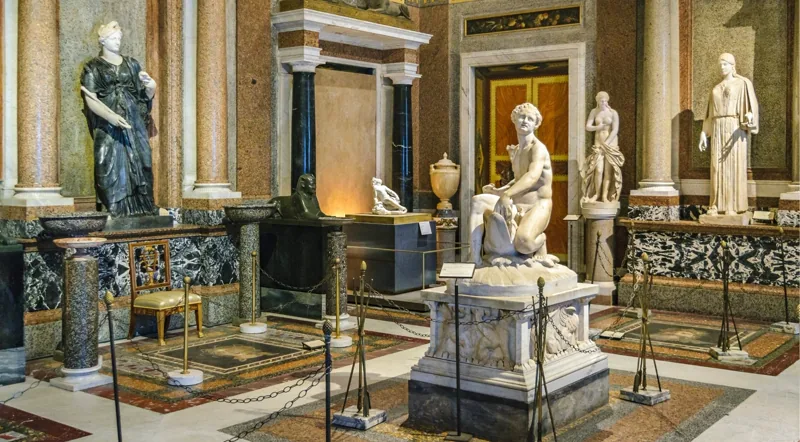
If these were the predator's methods, Scipione was also an inspired patron: it was he who spotted the talent of the very young Gian Lorenzo Bernini, commissioning from him between 1615 and 1623 the sculptural groups that remain the heart of the museum: the Goat Amalthea, Aeneas, Anchises and Ascanius (1618–1620, with the collaboration of his father Pietro), The Rape of Proserpina (1621–1622), Apollo and Daphne (1622–1625) and David (1623).
In 1632 Bernini also carved the celebrated portrait bust of the cardinal: during the work the marble revealed a flaw, a crack across the forehead, and the sculptor produced a second version in next to no time — three days according to his son Domenico, fifteen nights according to Baldinucci. Scipione wanted both versions, and they are displayed together in the gallery today. For the bust the sculptor was paid 500 scudi. The four groups are covered one by one in our guide to Bernini at the Borghese Gallery.
Building the villa: the Casino Nobile of the Villa Borghese Pinciana
Scipione's first great project as cardinal nephew was the creation of a suburban villa on the Pincio hill, just outside the walls, where the Borghese had owned a vineyard since 1580 (on the site of the ancient horti of Lucullus). From 1605–1606 the property grew through the purchase of neighbouring land and through donations, reaching an estate of about 80 hectares divided into three "enclosures".
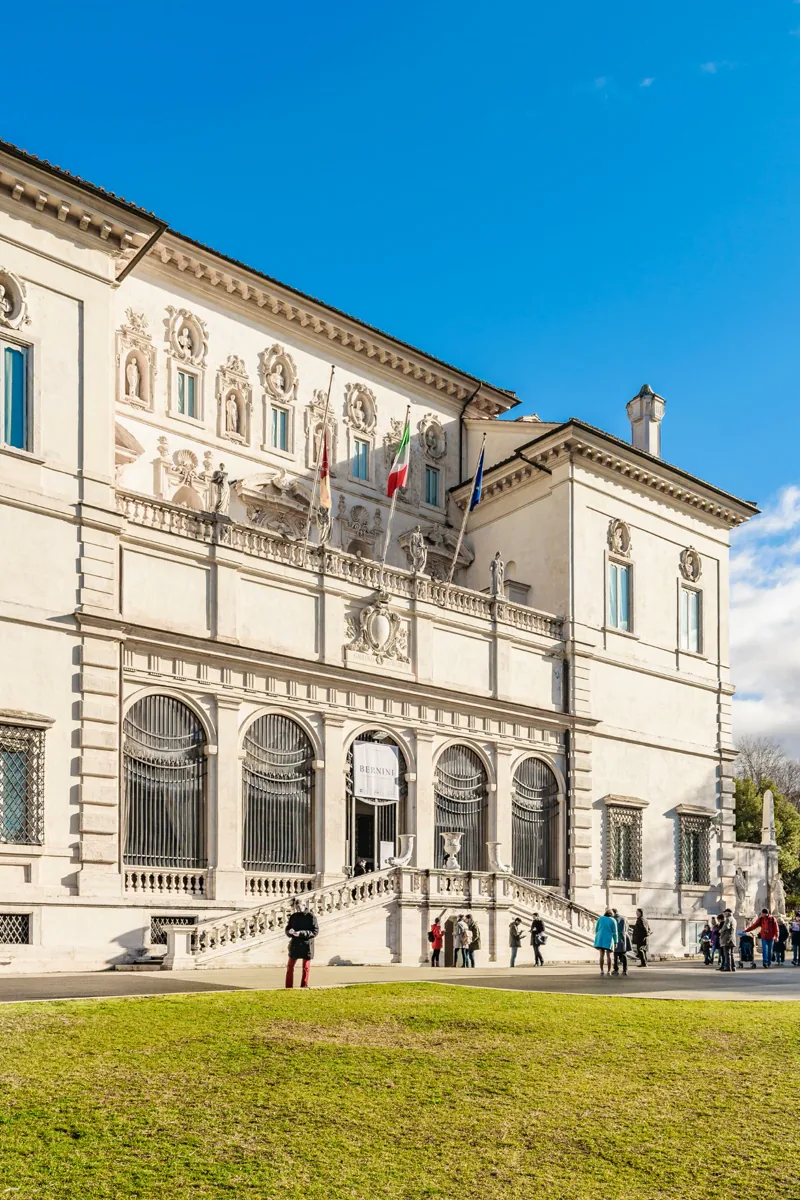
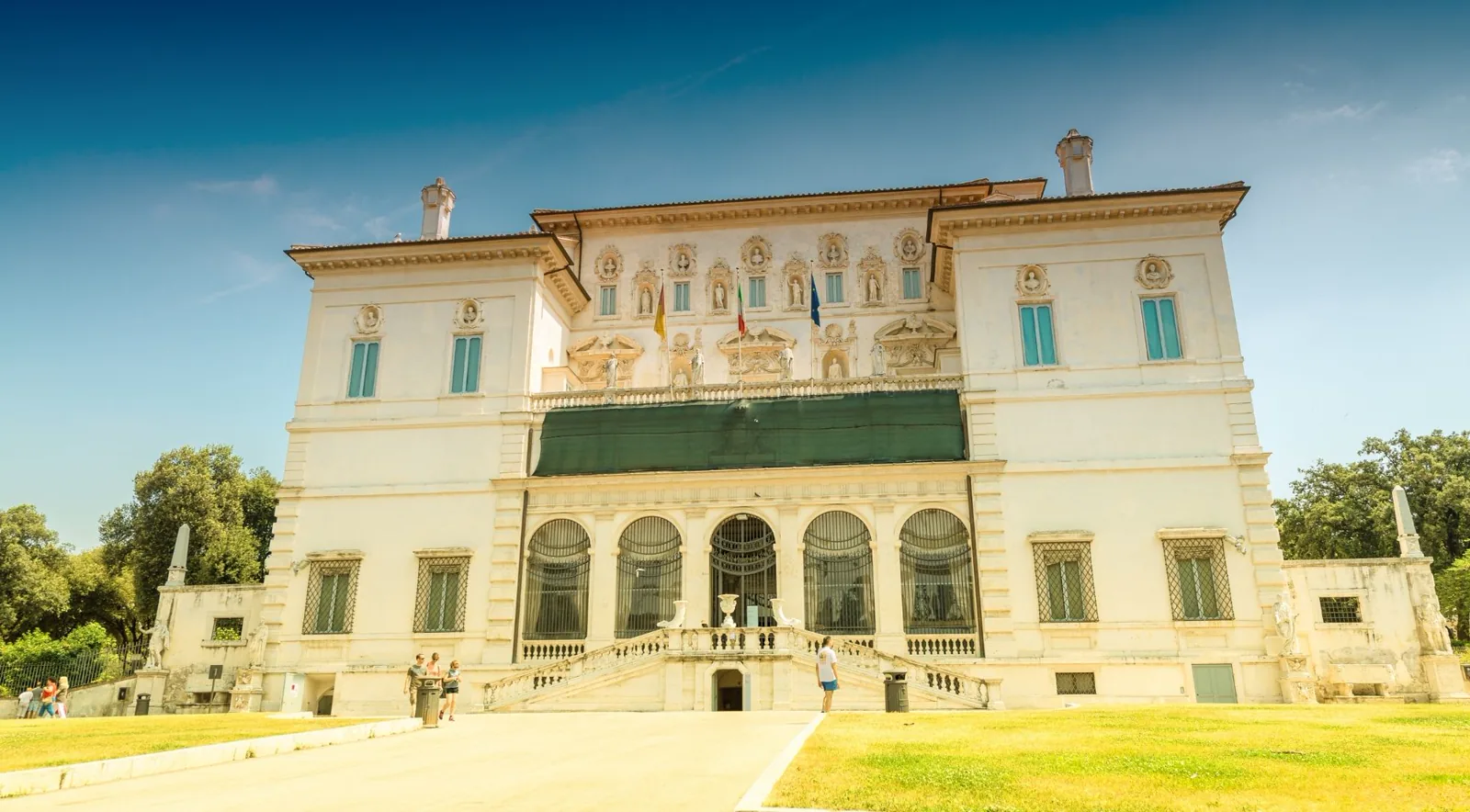
Construction of the Casino Nobile — the building that houses the gallery today — began around 1607 and was entrusted to the Borghese family architect, Flaminio Ponzio, already at work on the Palazzo Borghese. On Ponzio's death (1613) the work was continued by the Fleming Giovanni Vasanzio (Jan van Santen), who designed the elevation. The villa was substantially complete by 1633.
The building drew on the Renaissance suburban villas of Rome — in particular the Farnesina of Baldassarre Peruzzi (for the layout of the facade) and the Villa Medici (for the side turrets). Its most extraordinary feature was that the entire facade, like the two side elevations, was clad in ancient statues, reliefs, friezes and busts: the building appeared as a jewel standing "on an island", laden with archaeological marbles, in a late-Mannerist taste for horror vacui. The portico also reused spolia (ancient elements repurposed). The few sculptures on the facade today are not the originals: they were brought here at the end of the nineteenth century, after the Napoleonic despoliations.
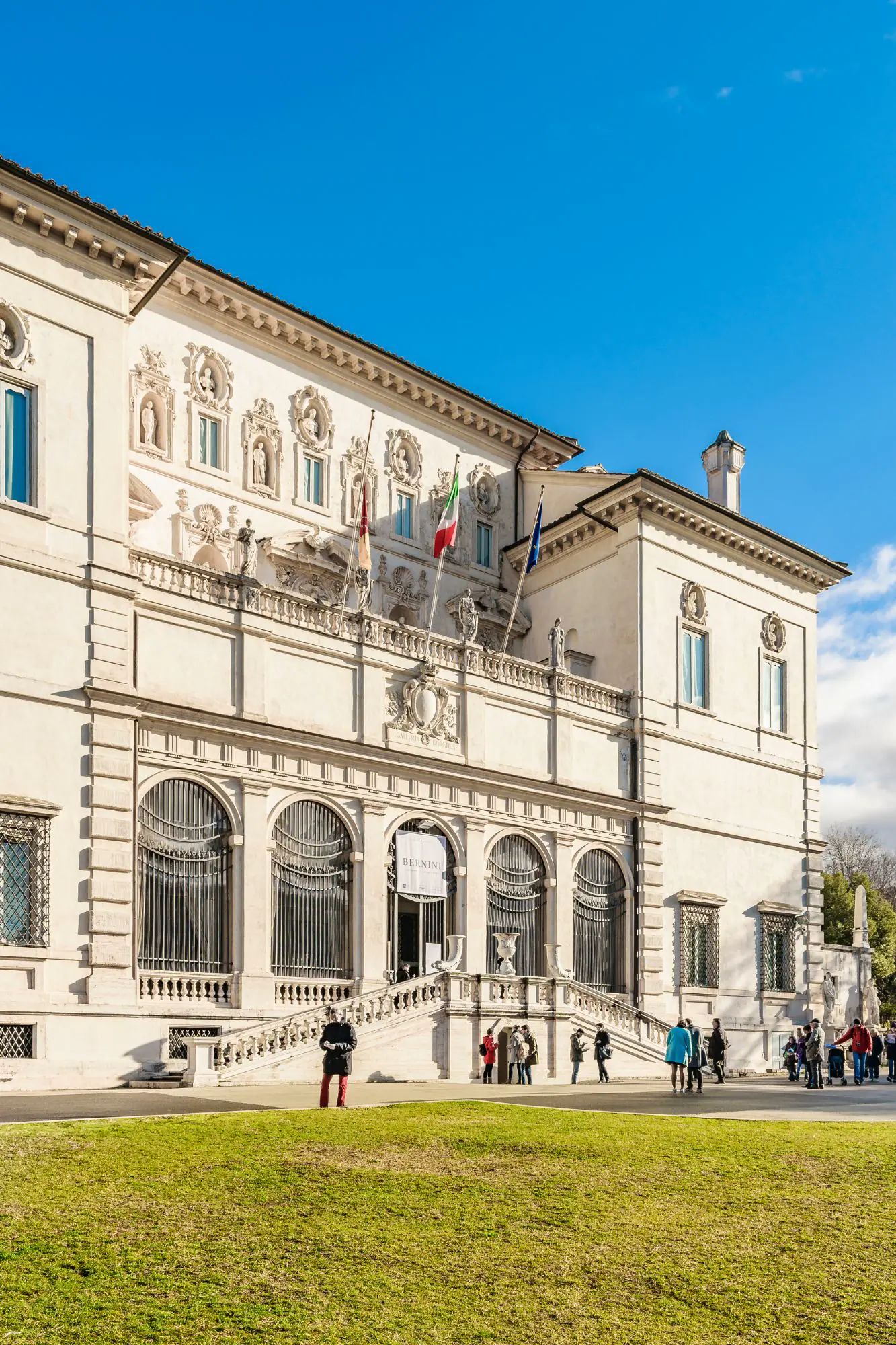
The essential point is that the Casino was not conceived as a residence, but as a "villa of delights" and a genuine museum: a place of culture for displaying exemplary images of ancient and modern art, for music, for study in a small library, for the contemplation of nature (with rare plants and exotic animals) and of the technological marvels of the age. The many windows and the arrangement of the rooms were designed precisely to help visitors see the works well.
Around the Casino lay the secret gardens: private enclosures on either side of the building, true "outdoor rooms" — the Garden of the Bitter Oranges and the Garden of Flowers — where citrus, Dutch roses and hundreds of rare ornamental species were grown, among them the bulbs at the centre of the seventeenth-century "tulip mania". The planting was the work of the gardener Domenico Savini da Montepulciano and the architect Girolamo Rainaldi, while the hydraulic works were entrusted to Giovanni Fontana. A precious description of the villa and its gardens is left to us by Jacopo Manilli, the villa's keeper of the wardrobe, in his Villa Borghese fuori di Porta Pinciana (1650).
The villa and the town palace
It is important to distinguish the suburban villa from the Palazzo Borghese in Campo Marzio, the family's principal residence in the city. Bought by Cardinal Camillo (later Paul V) and enlarged by Ponzio, Maderno and Vasanzio, the palace was nicknamed "the Harpsichord" for its unusual trapezoidal plan recalling the instrument, with the small facade on Via di Ripetta known as "the harpsichord's keyboard". It was considered one of the "wonders of Rome". For more than two centuries the palace housed, in twelve rooms, the family's picture collection, while the villa held mainly the sculpture.
Walking Scipione's gardens today
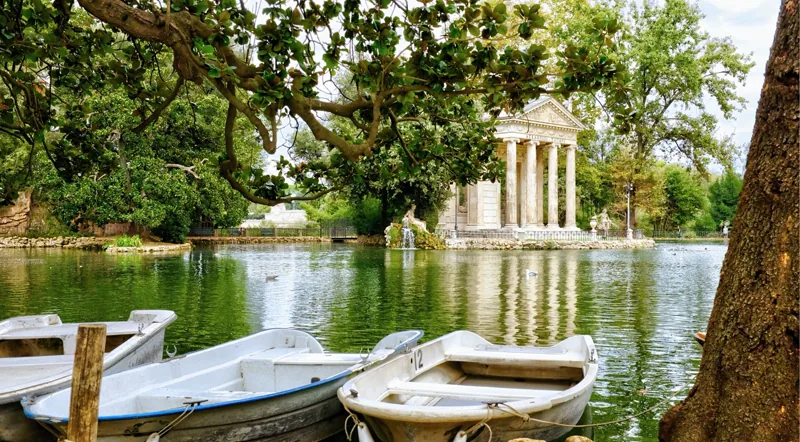
The park surrounding the museum is what remains of the cardinal's estate, and the visit that combines gallery and gardens is the one truest to the villa's original idea: a building and its greenery conceived together, not as two separate things.
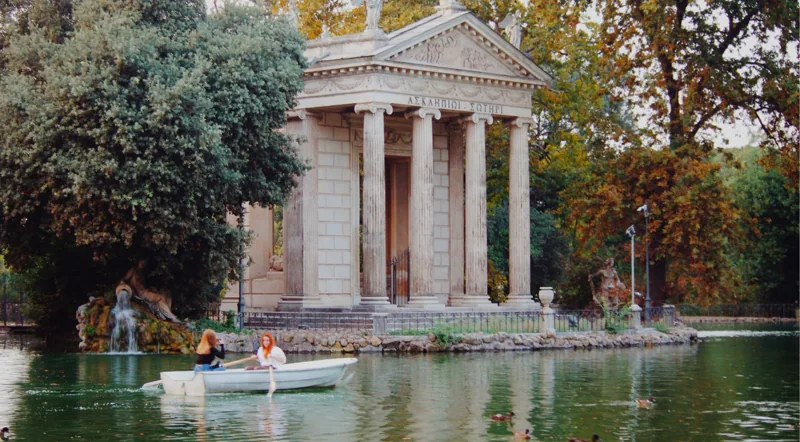
Borghese Gallery and gardens: small-group guided tour
Two and a half hours that hold together the two halves of Scipione's project: the rooms of the Casino Nobile and the greenery that surrounded it, with a small-group guide and entry in your booked slot. Rated 4.7 from 2,800+ reviews.
What became of the collection after Scipione
By the cardinal's will, on his death (1633) all his movable and immovable property was placed under a very strict entail (fedecommesso): a legal instrument that made the collection inalienable and preserved its integrity throughout the eighteenth century. The collection continued to grow — by the end of the seventeenth century the Borghese could count on some 800 paintings and one of the most celebrated collections of antiquities in Rome — thanks in part to the Aldobrandini inheritance that came to them at the end of the century.
In the eighteenth century Prince Marcantonio IV Borghese began a radical Neoclassical remodelling of the villa, entrusted to the architect Antonio Asprucci (c. 1766–1793): the arrangement of the rooms, with a masterpiece as the focus of each space, is still essentially Asprucci's.
The catastrophe of 1807
The gravest wound came with Camillo Borghese (1775–1832), who in 1803 had married Pauline Bonaparte, Napoleon's sister. Under the emperor's political and fiscal pressure, Camillo was forced to sell the French state most of the collection of antiquities, which between the end of 1807 and 1808 was dismantled from the villa and shipped to the Louvre (then the Musée Napoléon), where it still forms one of the foundational nuclei of the archaeological collection — the so-called "Borghese Fund".
Sources differ on the exact number of pieces. The modern scholarly catalogue by Marie-Lou Fabréga-Dubert for the Louvre, and the Borghese Gallery itself (for the 2011 exhibition I Borghese e l'Antico), give 695 pieces in total among statues, vases and reliefs. Within that total, the core of major sculptures is often described as 154 statues, 160 busts, 170 reliefs and 30 columns (besides various vases), a little over 500 major pieces; an earlier archival estimate by Ferdinand Boyer (1937) spoke of 523 "articles". The most famous piece was the Borghese Vase, and among the works that left were the Borghese Gladiator and the Sleeping Hermaphrodite restored by Bernini.
The initial commercial valuation by Ennio Quirino Visconti was around 6 million francs, but the agreed sum rose to 13 million francs. Of these, about 8 million were actually paid, and the remainder was only partly covered by the cession of the Lucedio estate, near Vercelli in Piedmont, where Camillo moved as governor general of the transalpine departments. Antonio Canova, who had studied those marbles, called it in 1810, in front of Napoleon, "an indelible disgrace" for the family that owned "the most beautiful villa in the world". Because it was a regular contract of sale — not a despoliation — the Congress of Vienna (1815) confirmed French ownership and the works never returned to Italy.
Camillo's rebuilding
In the following decades Camillo tried to make good the damage: he promoted new excavations on the family properties (through his agent Evasio Gozzani di San Giorgio), recovered and repurchased works, and commissioned two of the villa's best-loved masterpieces today: Antonio Canova's statue of Pauline Bonaparte as Venus Victrix and Correggio's Danaë, bought in 1827. In 1833 Prince Francesco Borghese renewed the entail, covering all movable and immovable works and saving the collection from further dispersal. These additions also include the discovery, in 1834, of the Gladiators Mosaic on the Torrenova estate.
The 1891 transfer and the state's purchase (1902)
At the end of the nineteenth century the family's severe financial reverses — debts of over 11 million lire between 1886 and 1891 — led to the sale of many properties. In 1891 all the works kept in the twelve rooms of the Palazzo Borghese picture gallery were moved to the main floor of the Villa Pinciana, preparing its transformation into a museum.
Finally, after long and complex negotiations, in 1902 the Italian state bought the collections of the Borghese entail together with the villa and the park for 3.6 million lire — an operation described as "the bargain of the century", because the sum, modest for the period, covered the estate, the mansion and all the priceless masterpieces it contained. The museum opened to the public at the start of 1902. The park, by contrast, was handed to the City of Rome in 1903 — its story is told in our guide to Villa Borghese.
The gallery's first director was Giovanni Piancastelli (1845–1926), succeeded in 1906 by Giulio Cantalamessa, previously head of the Gallerie dell'Accademia in Venice. Through the twentieth century the museum underwent numerous restorations: closed in 1983 for a radical architectural restoration lasting fourteen years, it reopened to the public in June 1997, with the original colours of the facades, the statues and the historic double-ramp staircase recovered.
| Year | What happened |
|---|---|
| 1605 | Scipione is made cardinal and adopts the Borghese name and arms |
| c. 1607–1633 | Construction of the Casino Nobile: Flaminio Ponzio, then Giovanni Vasanzio |
| 1633 | Scipione dies; the collection is tied up by the entail |
| c. 1766–1793 | Antonio Asprucci's Neoclassical rehang, still visible today |
| 1807–1808 | Sale to Napoleon: about 695 ancient pieces leave for the Louvre |
| 1833 | Francesco Borghese renews the entail |
| 1891 | The Palazzo Borghese picture collection moves to the Villa Pinciana |
| 1902 | The state buys collection, villa and park for 3.6 million lire |
| 1983–1997 | Closed for restoration; reopened June 1997 |
Visiting Scipione's collection today
The collection you see today at the Borghese Gallery is, for the most part, still the one Scipione assembled four centuries ago, with the same relationship between works and rooms: the Caravaggios from the Cavalier d'Arpino, Raphael's Deposition, Domenichino's Hunt of Diana, Titian's Sacred and Profane Love, the Bernini groups, Canova's Pauline, Correggio's Danaë.
Precisely because it is a museum housed in a historic villa, the visit is capped and by compulsory booking: entry is in timed slots, with a maximum number of visitors per slot and a limited visit duration. Tickets are bought through the museum's official channels. Prices, hours and arrangements are subject to change — particularly during temporary exhibitions — and should be checked on the official site before visiting. A comparison of the available formats is in our guide to guided tours, and the detail on fares and booking is in the tickets guide.
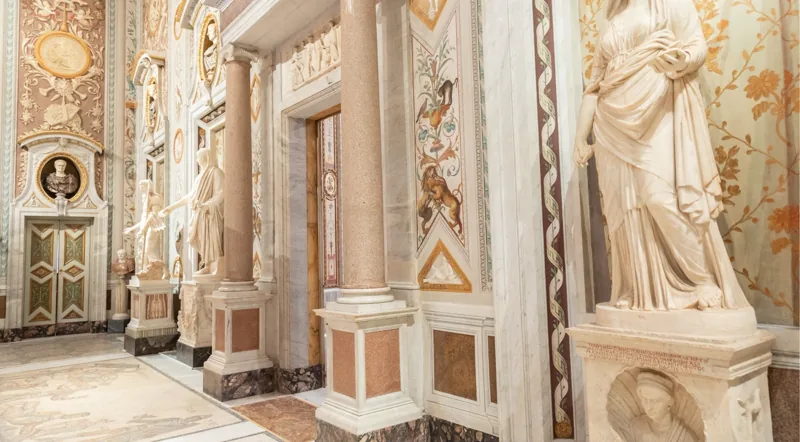
Small-group guided tour with skip-the-line entry
For a collection built out of stories — a seizure, a night-time theft, a painter in prison — a guide is what turns the rooms into a narrative. A licensed art historian, within the two-hour slot. Rated 4.7 from 2,700+ reviews.
On date and place of birth, most sources (Wikipedia, the 2025 Cuneo exhibition, museum materials) give Artena, 1 September 1577; some older ones — the short Treccani encyclopedia entry and the entry in the Dizionario Biografico degli Italiani — give "Rome, 1576": the prevailing and more reliable date is 1577, at Artena. On the number of pieces sold to Napoleon the figures vary widely (344, 514, 523, 695): the most authoritative and up to date is 695 (Fabréga-Dubert's catalogue for the Louvre, taken up by the Borghese Gallery in 2011); the figure of 344 given by Wikipedia is internally contradictory — its own sub-totals add up to 514 — and should be avoided. The construction dates of the villa vary slightly between sources (begun 1607/1608/1609; Vasanzio's facade around 1617): presenting them as a range, c. 1607–1633, is the more prudent choice. The agreed price of 13 million francs was never paid in full: the 8 million actually paid is confirmed by the gallery's official site, and some sources set out the structure of the payment (cash, the Lucedio estate and an annuity). Details of Scipione's private life come from contemporary sources (Gaetano Moroni) and should be treated as testimony, not established fact. Current hours and prices should always be checked on the official site.
Frequently asked questions
Answers to the questions that come up most about Scipione Borghese and the birth of the collection.
Who was Scipione Borghese?
A cardinal (1577–1633), nephew of Pope Paul V, effectively head of the papal government and one of the greatest collectors and patrons of Baroque Rome; the founder of the collection now in the Borghese Gallery.
Why is the collection called Borghese if Scipione was a Caffarelli?
Because on his appointment as cardinal in 1605 his uncle the pope adopted him, granting him the right to use the Borghese name and coat of arms.
Is it true that he stole works of art?
Partly, yes: he used pretextual legal seizures (the Cavalier d'Arpino), appropriations legitimised by papal decree (Raphael's Deposition) and even the imprisonment of an artist (Domenichino) to get what he wanted.
Was the villa his home?
No: the Casino Nobile was conceived as a «villa of delights» and a museum for the collection; the family's town residence was the Palazzo Borghese, «the Harpsichord».
What happened to the antiquities sold to Napoleon?
About 695 pieces (statues, busts, reliefs, vases, columns) have been in the Louvre since 1807–1808 and never returned to Italy, because it was a regular sale, confirmed by the Congress of Vienna.
When did the Italian state buy the Borghese Gallery?
In 1902, for 3.6 million lire: a modest sum that covered the collection, the villa and the park, which is why it is remembered as «the bargain of the century». The museum opened to the public at the start of 1902 and the park passed to the City of Rome in 1903.
Who built the villa that houses the Borghese Gallery?
The Casino Nobile was begun around 1607 to a design by Flaminio Ponzio, the Borghese family architect, and continued after his death in 1613 by the Fleming Giovanni Vasanzio, who designed the elevation. The villa was substantially complete by 1633.
What was the relationship between Scipione Borghese and Bernini?
Scipione was Gian Lorenzo Bernini's first great patron: between 1615 and 1623 he commissioned the Goat Amalthea, Aeneas Anchises and Ascanius, The Rape of Proserpina, Apollo and Daphne and David. In 1632 Bernini also carved his portrait bust, in two versions, paid 500 scudi.