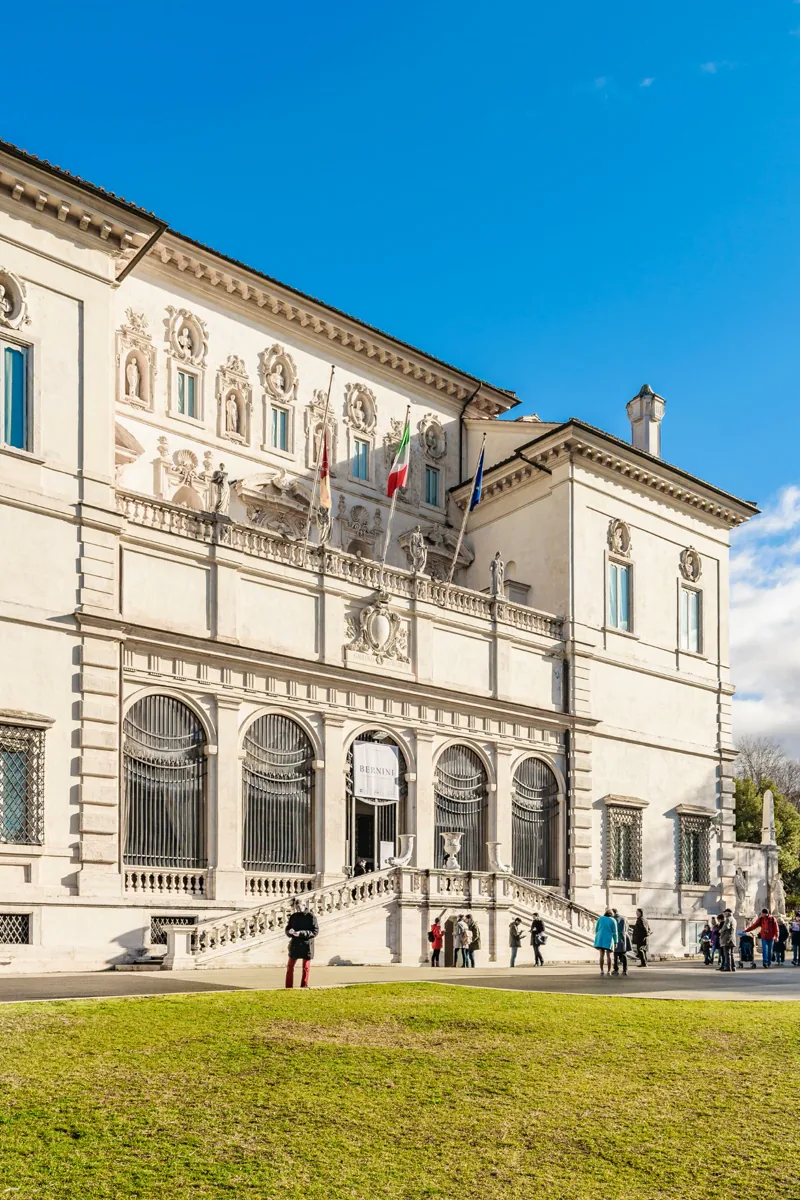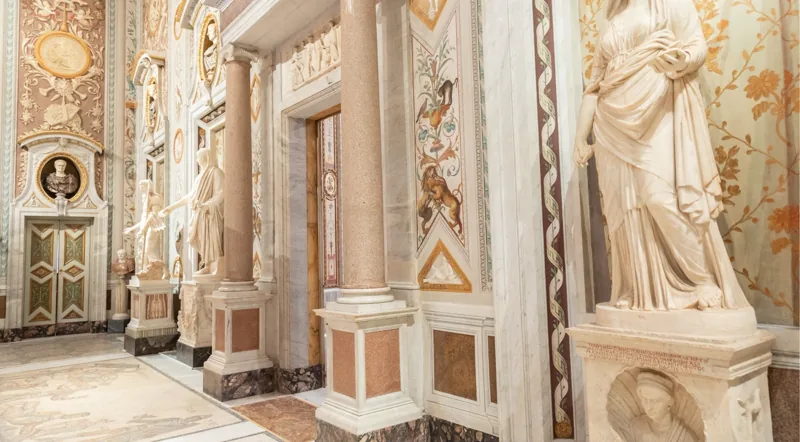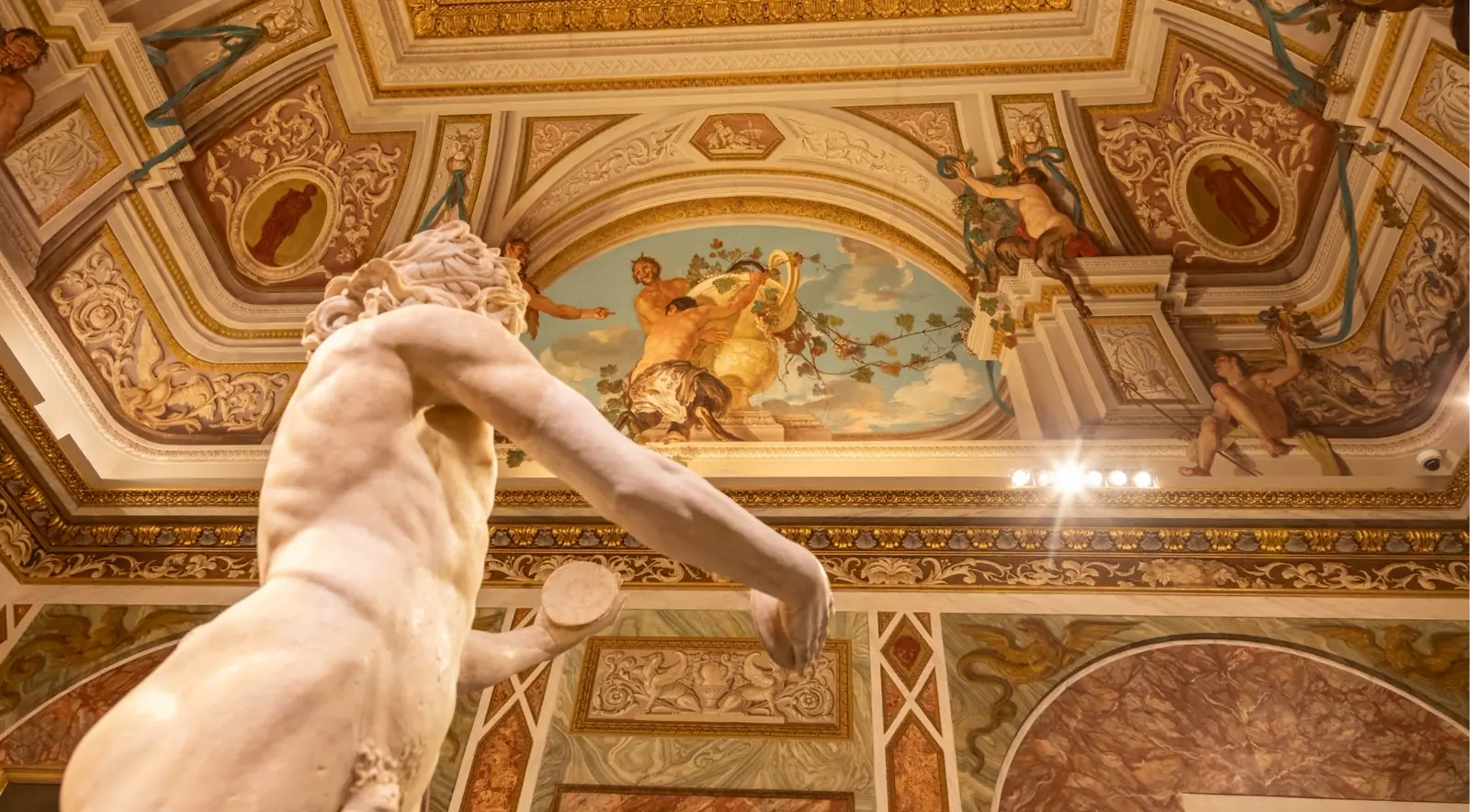
The Borghese Gallery holds six autograph paintings by Caravaggio — Boy with a Basket of Fruit, Sick Bacchus, St Jerome, Madonna of the Palafrenieri, St John the Baptist and David with the Head of Goliath — all gathered in Room VIII, the "Caravaggio Room". As the museum's official website puts it, "no museum in the world can boast six paintings by Caravaggio." This unique concentration comes from the ruthless passion of Cardinal Scipione Borghese, through confiscations, purchases and artistic diplomacy aimed at securing a papal pardon.
Who was Caravaggio: a life in darkness and light
Michelangelo Merisi, known as Caravaggio after his family's home town, was born in Milan in 1571. The son of Fermo Merisi and Lucia Aratori, in 1584 he signed a four-year apprenticeship contract in Milan with the painter Simone Peterzano. Around 1592-1595 the young Merisi arrived in Rome: they were hard years, working for other painters and spending time in the Ospedale della Consolazione, before he joined the workshop of Giuseppe Cesari, the Cavalier d'Arpino. The turning point came with Cardinal Francesco Maria Del Monte, his first great patron, who took him into his household after buying The Cardsharps.
Caravaggio's revolution is twofold: a radical naturalism — saints and Madonnas with the dirty faces and feet of ordinary people, blemished fruit, worn cloth — and a dramatic use of light, chiaroscuro pushed to the point of tenebrism, with figures emerging from dark backgrounds struck by raking beams of light.
His life was as turbulent as his art. On 28 May 1606, during a brawl linked to a game of pallacorda in the Campo Marzio district, Caravaggio fatally wounded Ranuccio Tomassoni. Sentenced to death in absentia, he fled Rome: first to the Colonna family's estates in Lazio, then to Naples, Malta and Sicily. He died on 18 July 1610 in Porto Ercole, while trying to make his way back to Rome in the hope of a papal pardon — signed, according to some sources, in those very days.
Other experiences in Rome not to miss
Caravaggio fans find a whole open-air itinerary in Rome: after the Borghese Gallery, it's worth reaching San Luigi dei Francesi and Santa Maria del Popolo, both free to enter. Many visitors pair the museum with a guided tour on Bernini and Caravaggio, a walk through the Villa Borghese gardens, or classics like the Vatican Museums.
Scipione Borghese: the collector cardinal and his Caravaggios
The true architect of the collection was Scipione Caffarelli Borghese (1577-1633), nephew of Pope Paul V, made cardinal nephew in 1605. Two of the youthful Caravaggios — the Sick Bacchus and the Boy with a Basket of Fruit — arrived in 1607 through the sensational confiscation of the Cavalier d'Arpino's collection, after he was accused of illegally holding firearms and forced to hand his picture gallery over to the Apostolic Chamber, which Paul V then gave to his nephew. The Madonna of the Palafrenieri, rejected from an altar at St Peter's, was bought by Scipione in 1606. The extreme late works — St John the Baptist and David with the Head of Goliath — are tied to his direct relationship with the cardinal, whom Caravaggio hoped might intercede with the pope for a pardon.
Scipione was not merely a predator: he was among the first to recognise the genius of both Caravaggio and Bernini, and on at least one occasion he witnessed a peace agreement that allowed the painter to return to Rome after an assault.
The Room of Caravaggio (Room VIII)
All six paintings are gathered on the ground floor of the Gallery, in Room VIII, also known as the Room of Silenus after the ancient Roman sculptural group at its centre. It is the last room on the ground-floor route and the heart of the visit for lovers of the master.
The six Borghese masterpieces, one by one
1. Boy with a Basket of Fruit, c. 1593-1595
An early Roman work, which came to Scipione with the 1607 confiscation. A young man posed in three-quarter view holds a basket brimming with autumn fruit — apples, peaches, figs, pomegranates and three varieties of grape — rendered with meticulous realism, blemishes and yellowing leaves included. Critics have read it as a vanitas (an allegory of transience); the model is traditionally identified as his Sicilian friend Mario Minniti.
2. Sick Bacchus, c. 1593-1595
This canvas too came from the confiscation of the Cavalier d'Arpino's collection. It shows a young man with the attributes of Bacchus — an ivy crown, a bunch of white grapes — but with a pale, bluish, "sickly" complexion. Critics, starting with Roberto Longhi, have recognised it as a self-portrait of the artist, perhaps painted during or after his convalescence at the Ospedale della Consolazione.
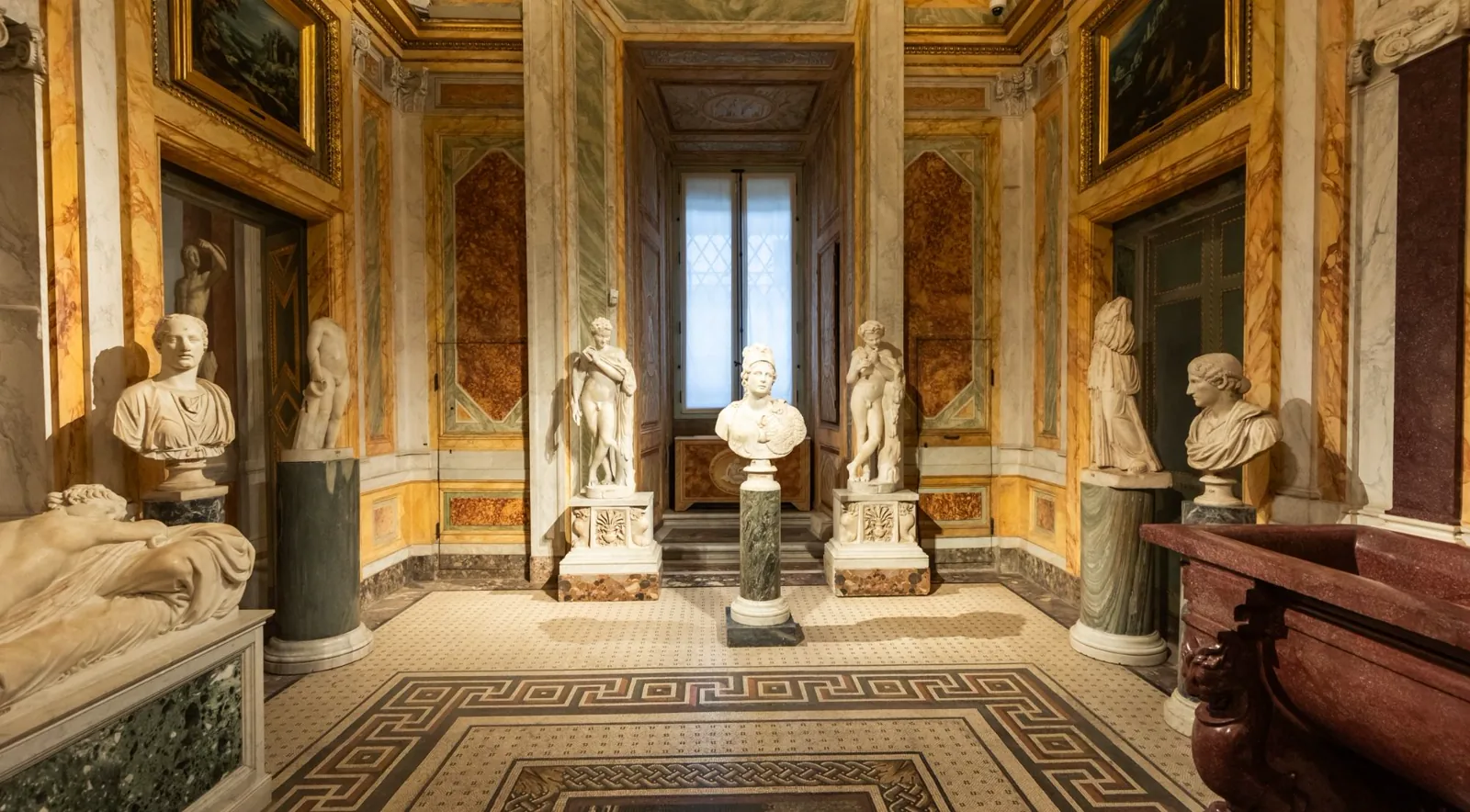
3. St Jerome, c. 1605-1606
Painted for Cardinal Scipione Borghese, as the biographer Giovanni Pietro Bellori attests. The saint is portrayed not as a penitent hermit but as a man of learning, bent over his books, pen reaching toward the inkwell. On the table, a small still life with a skull (memento mori) acts as a symbolic counterpoint: life and death, knowledge and eternity.
4. Madonna of the Palafrenieri, 1605-1606
A large altarpiece for St Peter's Basilica, delivered on 8 April 1606. It shows the Virgin, helped by the Child, crushing the serpent of sin, while St Anne looks on from the side. Removed from the altar only days later, Cardinal Scipione bought it on 20 July 1606 for 100 scudi. The reasons for its rejection remain debated: the Virgin's too "common" realism, the Child's nudity, or simply the cardinal's wish to own it.
5. St John the Baptist, c. 1609-1610
A work from his very last years, showing the Baptist as a meditative adolescent beside a ram, without the usual iconographic attributes. It was part of the luggage Caravaggio carried with him on his journey from Naples back toward Rome, intended as a gift to the cardinal in exchange for a pardon. After the painter's death, the picture reached Rome only in August 1611.
6. David with the Head of Goliath, 1609-1610
The most dramatic and autobiographical of the six. David holds Goliath's severed head by the hair, but his face shows not triumph but pity and melancholy. In the twisted face of the decapitated giant, seventeenth-century sources recognise a self-portrait of Caravaggio — a macabre self-condemnation, tied to his hope of obtaining a papal pardon. On the blade the letters "H·AS OS" can be read, unravelled as the Augustinian motto Humilitas occidit superbiam ("humility kills pride"). Today it is the last work on the Room VIII route.
The dates proposed for the early works vary depending on how scholars reconstruct his first Roman period. The Borghese Gallery nonetheless confirms the number of six autograph works by the master gathered in Room VIII.
See the six Caravaggios with an art historian
A small-group guided tour helps you grasp, in just a few minutes, why each canvas in Room VIII marks a different stage of Caravaggio's story: the guide walks you past the originals during your two-hour slot, explaining the ties between the works and Cardinal Scipione.
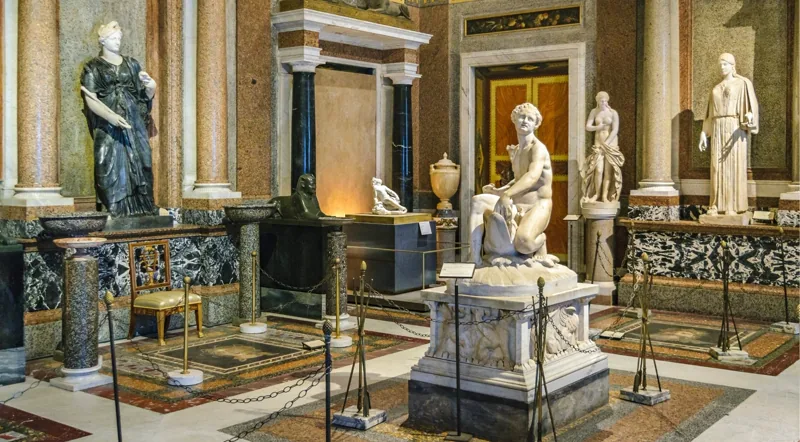
Small-group guided tour with skip-the-line entry
A licensed art historian guides you through the Room VIII Caravaggios, Bernini's marbles and Canova's Pauline, at the pace of your 2-hour slot. Rated 4.7 from over 2,700 reviews.
Where to see Caravaggio in Rome (beyond the Borghese Gallery)
Rome is the Caravaggio city par excellence. Here are the essential stops:
- San Luigi dei Francesi — Contarelli Chapel (free entry): the three great canvases of the Stories of St Matthew — the Calling, the Martyrdom and St Matthew and the Angel — painted between 1599 and 1602, the master's first public commission.
- Santa Maria del Popolo — Cerasi Chapel (free entry): the Conversion of St Paul and the Crucifixion of St Peter, from 1600-1601, flanking Annibale Carracci's Assumption.
- Sant'Agostino — Cavalletti Chapel (free entry): the Madonna of the Pilgrims (1604-1606), showing the Virgin appearing to two kneeling pilgrims with dirty feet in the foreground.
- Vatican Pinacoteca (ticket required): the Deposition (1600-1604), one of the master's greatest masterpieces.
- Doria Pamphilj Gallery (ticket required): the Rest on the Flight into Egypt, the Penitent Magdalene and a St John the Baptist.
- Palazzo Barberini (ticket required): Judith and Holofernes and the (attributed) Narcissus.
- Capitoline Museums (ticket required): a St John the Baptist and the Fortune Teller.
For those who want to build a tailor-made Caravaggio itinerary, with a guide dedicated solely to their group, a private tour adapts the pace and themes to your interests — from the Borghese Gallery to the churches of the historic centre.
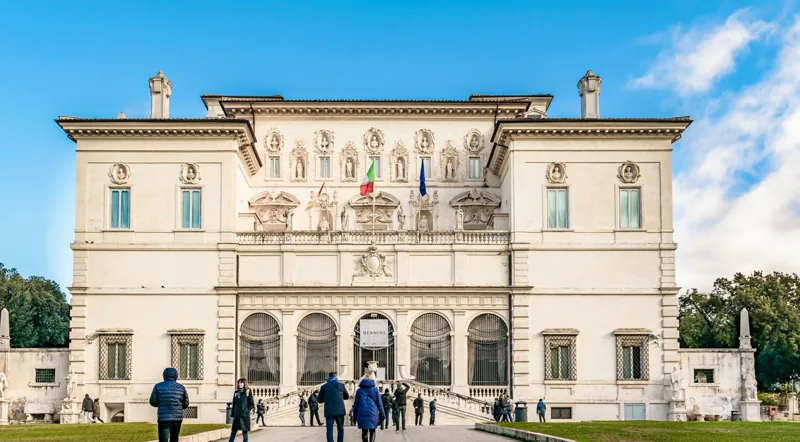
Private guided tour of the Borghese Gallery
Two hours with a guide all to yourself: focus on the six Room VIII Caravaggios, on Bernini, or on Canova, at a personalised pace. Early reviews are a perfect 5/5.
How to see them: visit and tickets
Visiting the Borghese Gallery requires mandatory booking: access runs in two-hour slots, with a cap of around 180 visitors per slot. The museum is open Tuesday to Sunday, 9:00 am to 7:00 pm (last entry 5:45 pm), closed Mondays. A full-price ticket costs €16 plus a €2 mandatory booking fee (€18 total), with the last evening slot at €11 (plus booking fee). Prices and hours should always be checked on the official website, as they are subject to change.
For full details on rates and time slots, see our guide to Borghese Gallery tickets; for a complete comparison of the official guided tour, audioguide, small-group tour and private tour, check our guide to guided tours. For the history of the villa and its other collections, see the complete guide to the museum.
Build a day-long Caravaggio itinerary combining the free churches of the centre, all a short distance from each other around Piazza Navona, with a booked visit to the Borghese Gallery. Always check for temporary loans: some works, such as the Boy with a Basket of Fruit, have been lent abroad for exhibitions more than once.
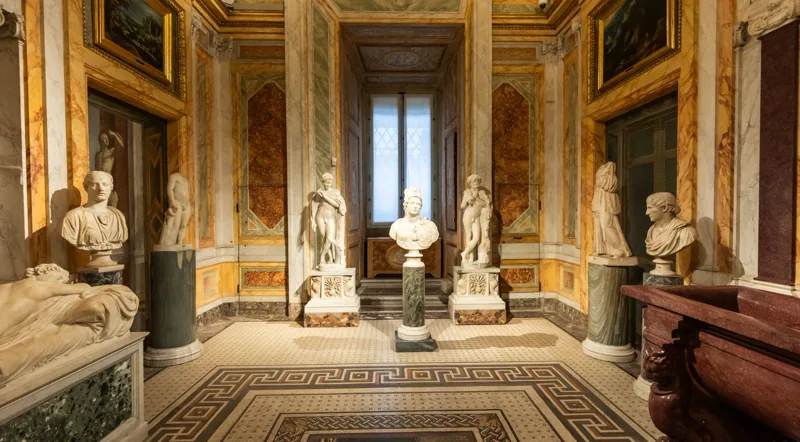
Ticket + audioguide or guided tour (optional)
The same skip-the-line ticket, with the option to add — at the time of booking — an audioguide or a guided tour that tells the story of the six Room VIII Caravaggios. Rated 4.5 from over 3,500 reviews.
Frequently asked questions
Answers to the most common questions about Caravaggio at the Borghese Gallery.
How many Caravaggio paintings are at the Borghese Gallery?
Six autograph paintings: Boy with a Basket of Fruit, Sick Bacchus, St Jerome, Madonna of the Palafrenieri, St John the Baptist and David with the Head of Goliath. It is the richest collection of Caravaggio's work in the world, gathered in a single room.
Where are the Caravaggios inside the Borghese Gallery?
All six are in Room VIII on the ground floor, also known as the Room of Silenus after the ancient Roman sculptural group at its centre. It is the last room on the ground-floor route.
Which is the most famous Caravaggio at the Borghese Gallery?
David with the Head of Goliath (1609-1610): seventeenth-century sources identify the disfigured face of Goliath as a self-portrait of the artist, a macabre self-condemnation tied to his hope of obtaining a papal pardon.
Where else can you see Caravaggio in Rome for free?
Free of charge in the churches of San Luigi dei Francesi (Contarelli Chapel), Santa Maria del Popolo (Cerasi Chapel) and Sant'Agostino (Madonna of the Pilgrims). Other works can be seen with a paid ticket at the Vatican Pinacoteca, Doria Pamphilj, Palazzo Barberini and the Capitoline Museums.
Do you need to book to see the Caravaggios at the Borghese Gallery?
Yes, it's mandatory for everyone, even for free tickets, with access organised in two-hour slots capped at around 180 people. See our guide to tickets to book.