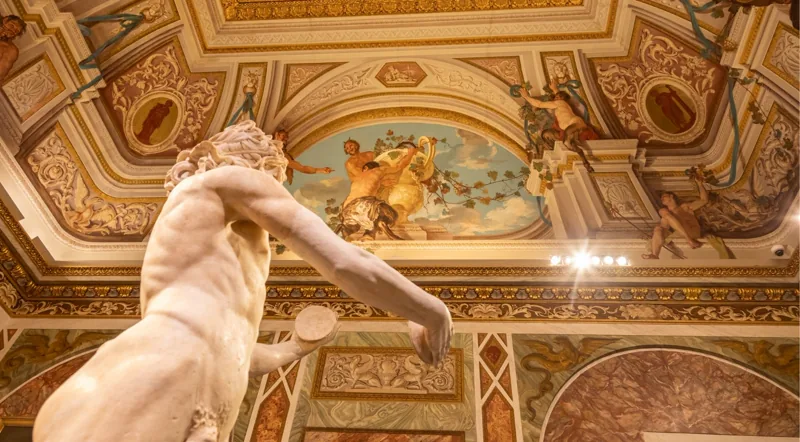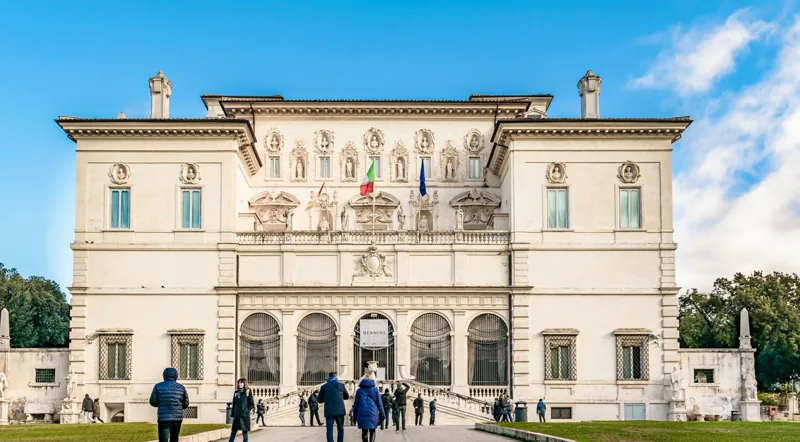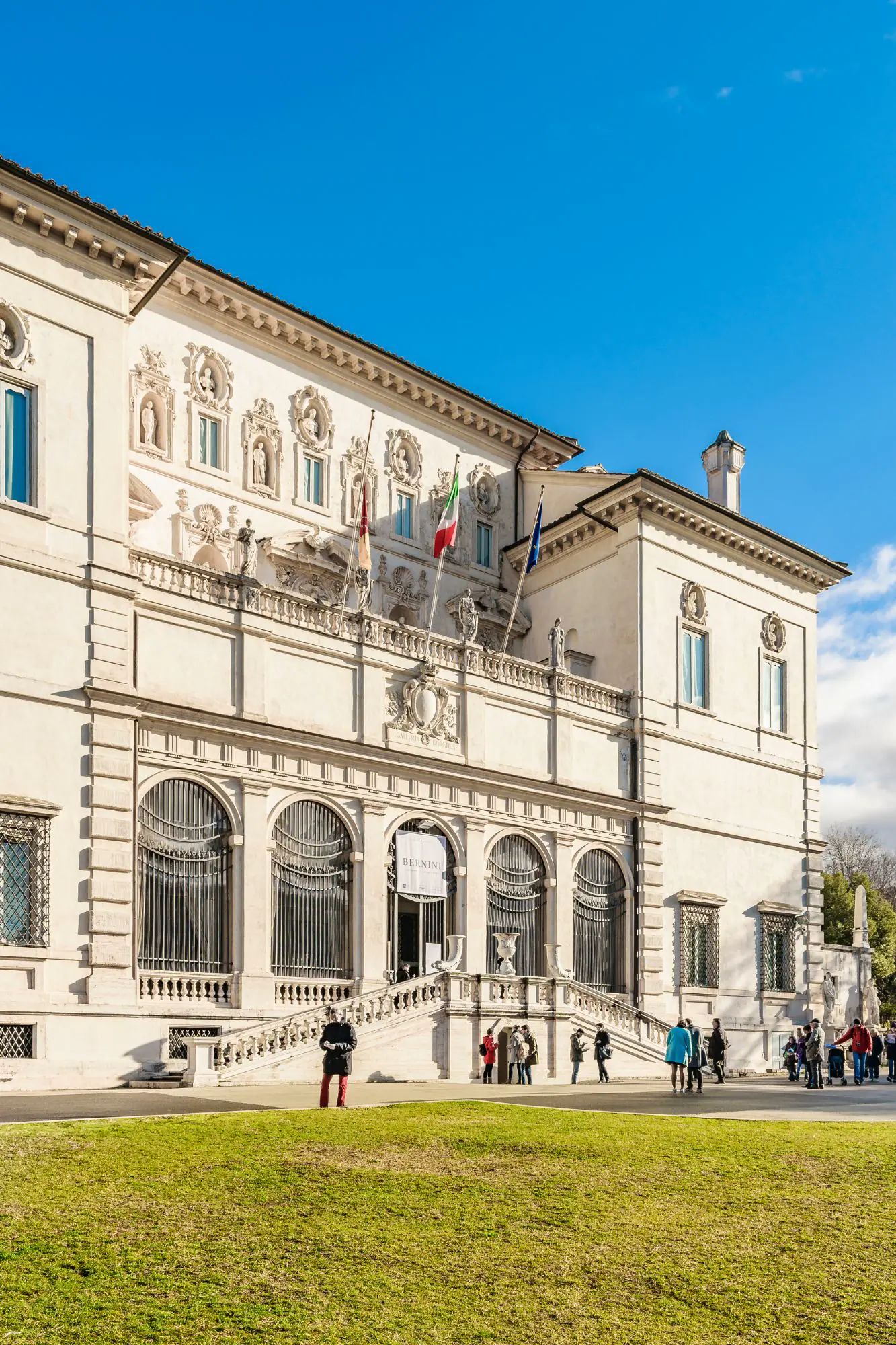
The Borghese Gallery is the state museum that, inside Rome's Villa Borghese park, displays Cardinal Scipione Borghese's art collection. It's unique in the world for the number of Bernini sculptures and Caravaggio paintings it holds. Entry is by mandatory booking only — for everyone, even those entering free — in two-hour slots of around 180 people. Open Tuesday–Sunday, closed Mondays. Tickets sell out well in advance: book early.
What is the Borghese Gallery
The name "Borghese Gallery" refers to two things at once: the extraordinary art collection begun in the early 1600s by Cardinal Scipione Borghese, and the building that houses it, the Casino Nobile of Villa Borghese Pinciana. Today it's a state museum under the Ministry of Culture, with special autonomy, directed by Francesca Cappelletti since November 2020. In 2024 it recorded roughly 599,000 visitors, among the most visited state cultural sites in Italy.
The museum displays ancient sculptures, reliefs, and mosaics, alongside paintings and sculptures from the 15th to the 19th century. It's considered unique in the world for the number and importance of the Gian Lorenzo Bernini sculptures and Caravaggio paintings it holds. One useful distinction: the Borghese Gallery (the museum, paid entry, booking required) shouldn't be confused with Villa Borghese, the large free public park that surrounds it. The museum sits inside the park, but visiting it requires a ticket.
Since each slot admits only a limited number of visitors and tickets sell out weeks in advance, it's worth locking in a date and time as early as possible. The most popular package is the skip-the-line ticket with digital audio guide: the same experience as official entry, with the guarantee of a slot even when the museum's own site shows sold out.
Book the skip-the-line ticket with audio guide
Skip-the-line ticket with audio guide
Priority entry with a guaranteed time slot and a digital audio guide covering Bernini, Caravaggio, Canova, and Raphael. Rated 4.6 from 2,700+ verified reviews — stay up to 4 hours.
History: from Cardinal Scipione to the state museum
The Borghese family was a wealthy Sienese dynasty. Their rapid rise in Rome culminated in 1605 with the election of Camillo Borghese as pope, who took the name Paul V. It was the pope's favorite nephew, Cardinal Scipione Caffarelli Borghese (1577–1633), who became the great protagonist of patronage at the papal court.
Construction of the villa, begun in 1607, was directed by the architect Flaminio Ponzio and completed, after his death in 1613, by Giovanni Vasanzio (the Flemish Jan van Santen). The building wasn't built as a residence, but as a kind of museum ante litteram: a place dedicated to displaying ancient and modern art, to music, and to the contemplation of nature, conceived from the start to house the cardinal's collection.
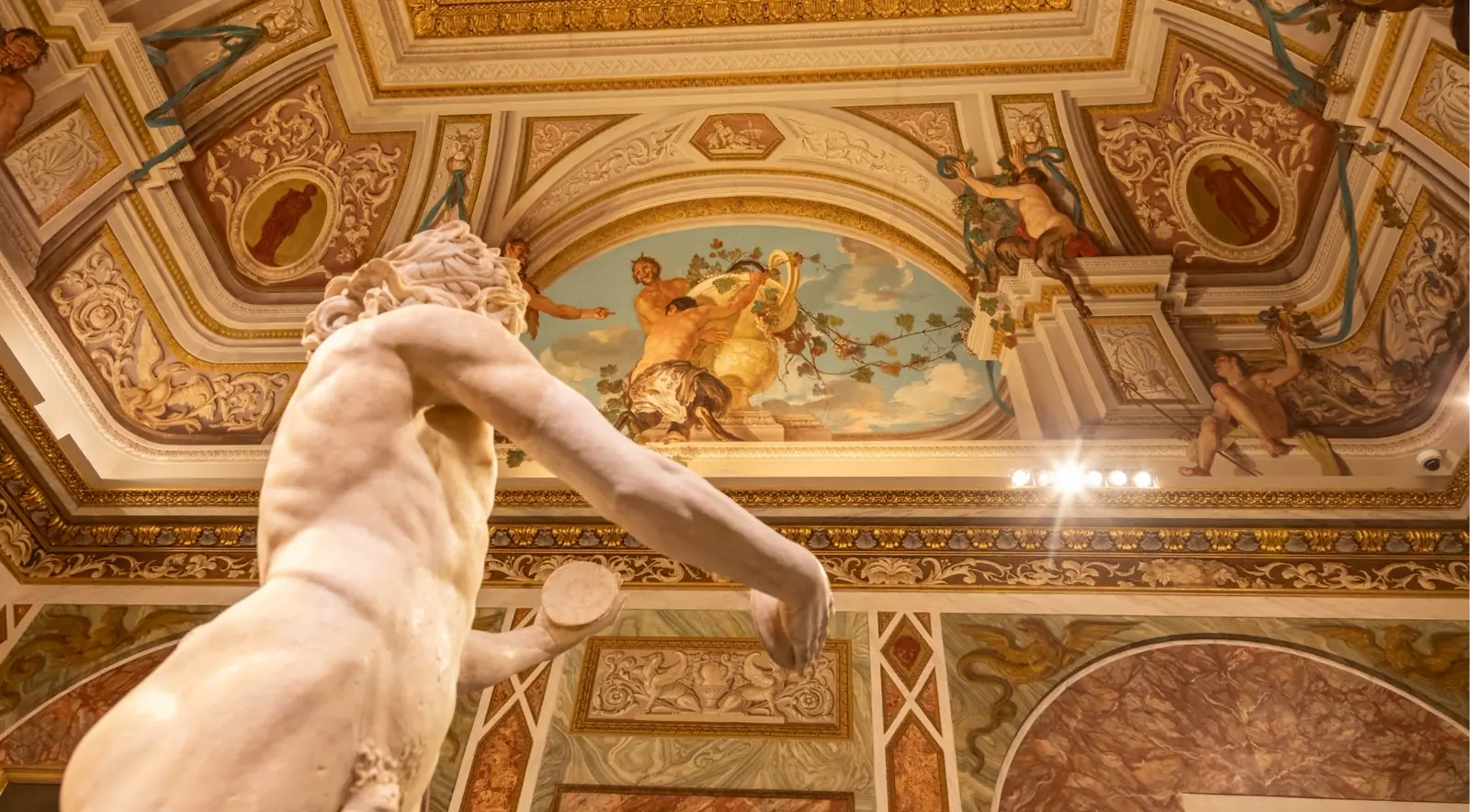
Purchases, commissions, and "thefts"
Scipione Borghese was a passionate and ruthless collector. His collection grew through purchases, inheritances, papal gifts, and outright power plays. In 1607, thanks to a seizure carried out by the papal treasury in the Cavalier d'Arpino's studio, he came into possession of 107 paintings, including some of Caravaggio's early works. Famous episodes tell of his methods: Raphael's Deposition was removed at night, in March 1608, from the Church of San Francesco al Prato in Perugia; Domenichino was imprisoned for several days for refusing to hand over Diana's Hunt.
The loss: the 1807 sale to Napoleon
The collection's hardest blow came in the early 1800s. In 1803, Camillo Borghese had married Pauline Bonaparte, Napoleon's sister. Under an 1807 imperial decree, Napoleon bought the Borghese antiquities collection from his brother-in-law — according to the official museum source, 154 statues, 160 busts, 170 reliefs, and 30 columns. Those works still form the "Fondo Borghese" at the Louvre today and were never recovered.
The birth of the public museum
In 1902 the Italian state acquired the Borghese Fedecommesso's collections along with the villa and park, a deal described as "the deal of the century." After a long closure for restoration, the museum reopened in its current layout in 1997. Since then, the Borghese Gallery has been one of Rome's most loved and most in-demand museums.
Other Rome experiences you shouldn't miss
If you're building out your Rome itinerary, the Borghese Gallery pairs naturally with other experiences around the city. Many visitors combine the museum with a walk through the Villa Borghese gardens, a tour dedicated to Bernini's sculptures and Caravaggio's paintings, or a guided visit combined with the Pincio terrace and Piazza del Popolo. The Vatican Museums and the historic center's other classics are also great additions if you're staying longer in Rome.
The visit route: the rooms and the masterpieces
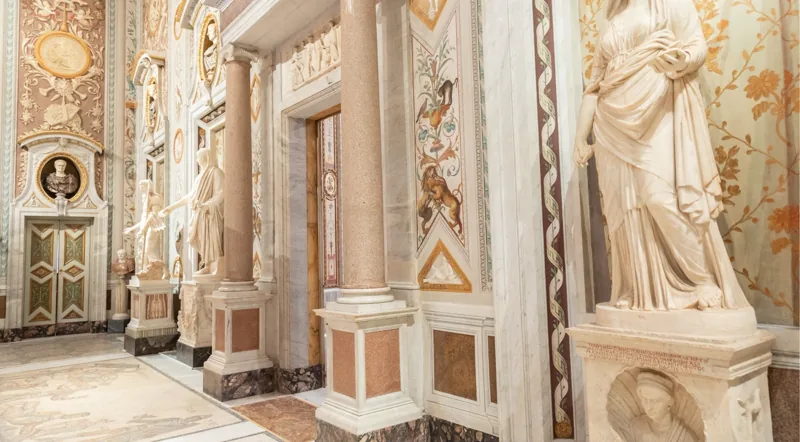
The works are displayed across twenty frescoed rooms which, together with the portico and entrance hall, make up the spaces open to the public. The museum is arranged over two levels: the ground floor for sculpture, the upper floor for the Pinacoteca (picture gallery).
Portico and entrance hall
The entrance greets visitors with classical themes: busts of emperors, a statue of Augustus, Bernini's Truth sculpture, and, set into the floor, the celebrated Mosaic with scenes of hunting and gladiatorial combat, from the early 4th century AD. The hall's vault is dominated by an imposing trompe-l'œil fresco by the Sicilian painter Mariano Rossi.
The ground floor: Bernini and Canova
- Room I (of Pauline): Antonio Canova's Pauline Borghese as Venus Victrix (1805–1808), reclining on a marble mattress rendered with extraordinary softness.
- Room II (of David): Bernini's David (1623–1624), caught in the instant before releasing the stone; the tense face is said to be a self-portrait of the young sculptor.
- Room III (of Apollo and Daphne): the world-famous Apollo and Daphne by Bernini (1622–1625), which captures the exact instant of the nymph's transformation into a laurel tree.
- Room IV (of the Emperors): Bernini's Rape of Proserpina (1621–1622), where Pluto's fingers sink into Proserpina's marble flesh; also here, the busts of Cardinal Scipione and Pope Paul V.
- Room VI (of Aeneas and Anchises): Bernini's first major work, Aeneas, Anchises and Ascanius (1618–1619), on the theme of pietas and the flight from Troy.
Bernini's four great sculptures were carved between the ages of nineteen and twenty-six and are considered seminal works of Baroque sculpture. A guided tour is the best way to grasp the technical choices that make them revolutionary: an art historian walks you right up to the originals during your two-hour slot.
The most-loved guided tour
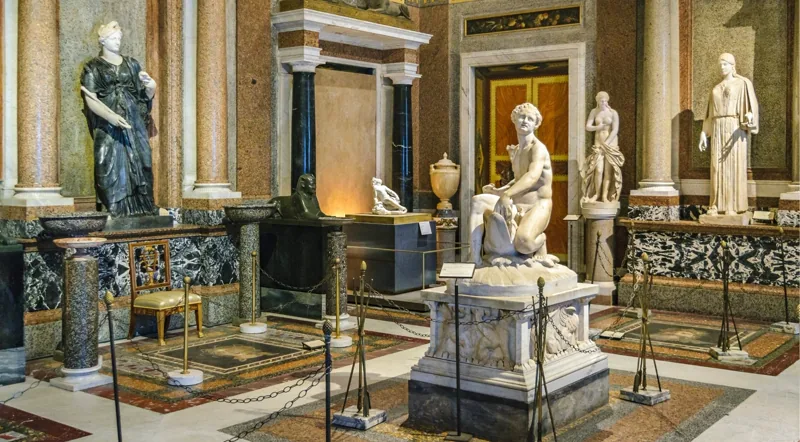
Small-group guided tour with skip-the-line entry
A licensed art historian guides you through Bernini, Caravaggio, and Canova at the pace of the 2-hour slot. Rated 4.7 from 2,700+ reviews — the most-loved guided tour in this lineup.
The six Caravaggios
The Gallery holds six Caravaggio paintings, a record number that makes it one of the largest collections of the artist's work in the world. Among them: Boy with a Basket of Fruit, Sick Bacchus (early works), Madonna dei Palafrenieri, Saint Jerome Writing, Saint John the Baptist, and David with the Head of Goliath, in which Goliath's severed head is thought to be a self-portrait of the painter. For the story of each work and where to find them in Room VIII, see our guide to Caravaggio at the Borghese Gallery.
The upper floor: the Pinacoteca
Twelve rooms form an anthology of painting from the 15th to the 18th century. Not to be missed: Raphael's Deposition (Baglioni Altarpiece, 1507) and the Lady with a Unicorn; Correggio's Danaë; Domenichino's Diana's Hunt; and, among the Venetian masters, Titian's Sacred and Profane Love (1514), alongside works by Giorgione, Veronese, Bellini, and Antonello da Messina. Paintings by Rubens and the Carracci are also on view.
Start on the upper floor (the Pinacoteca), not the ground floor. Most visitors go straight for Bernini and reach the paintings already tired, rushing past the Caravaggios. Reverse the route: spend the first part of your slot on paintings while you're fresh, then head down to the sculptures once your visual energy has recharged.
Practical information for your visit
Prices, hours, and rules change frequently, especially during temporary exhibitions. The figures below come from the official source but should always be verified before your visit.
Mandatory booking and time slots
The Borghese Gallery isn't a museum like any other: for security reasons tied to the building's historic structure, booking is mandatory for everyone, including categories entitled to free entry. Access is organized in timed sessions starting every hour (from 9 AM to 5 PM, plus a shorter slot at 5:45 PM); each slot admits a maximum of about 180 people and lasts two hours. At the end, visitors are guided out, but may stay freely in the park.
Hours and closing days
The gallery is open Tuesday–Sunday, 9 AM–7 PM, with last entry at 5:45 PM and the ticket office opening at 8:30 AM. Closed weekly on Mondays. Also closed December 25 and January 1.
Ticket prices (verify before booking)
| Type | Price | Notes |
|---|---|---|
| Full price | €16 | Last slot €11 |
| Reduced 18–25 (EU) | €2 | Until the day of your 25th birthday |
| Under 18 | Free | Booking still mandatory |
| Booking fee | €2 | Mandatory for every ticket type |
A full-price ticket therefore costs €18 total (€16 + €2). Prices may vary during temporary exhibitions. Figures indicative as of 2026-07 — re-verify on the official site.
What to do if it's sold out
Since slots hold only around 180 people, tickets sell out weeks or months in advance, especially on weekends and during exhibitions. When the official site is "sold out," the most reliable option is a package that includes the skip-the-line ticket with the option to add a live guide: authorized resellers hold separate inventory and often find available slots.
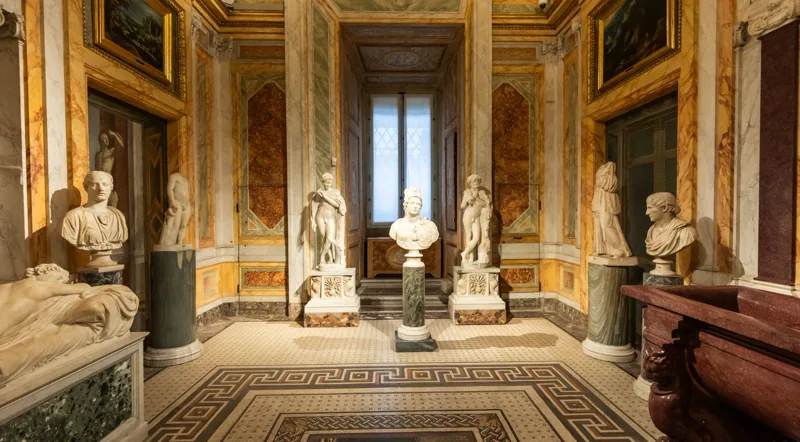
Ticket + audio guide or guided tour (your choice)
Same skip-the-line ticket, with the option to add — at checkout — a guided tour in Italian, English, French, German, Spanish, or Portuguese. Rated 4.5 from 3,500+ reviews.
Free entry: the first Sunday of the month
Entry is free for everyone on the first Sunday of each month and on certain public holidays. Even then, booking remains mandatory and the €2 booking fee still applies. Tickets open 10 days ahead and there are no last-minute tickets.
Where it is and how to get there
The address is Piazzale Scipione Borghese 5, 00197 Rome, inside Villa Borghese.
- Metro: Line A, Spagna stop (about 15–20 minutes on foot through the park) or Flaminio.
- Bus: lines 52, 53, 63, 83, 92, 223, 360, 910 stop at "Pinciana/Museo Borghese"; the electric bus 116 crosses the park.
- Tram: lines 3 and 19 near the Bioparco/Viale delle Belle Arti area.
- Car: not recommended due to traffic and restricted zones; paid parking is available at the edges of the park.
Services and rules
- Mandatory cloakroom: no entry with medium-to-large bags, backpacks, umbrellas, or selfie sticks; only a small pouch/fanny pack up to 21 × 15 cm is allowed.
- Audio guides for rent at the desk next to the ticket office; many skip-the-line packages already include the app version.
- Accessibility: access for visitors with reduced mobility from the basement level; upper floor reachable by elevator.
- Recommended duration: the two-hour slot is enough; arrive 20–30 minutes early for ticket pickup and the cloakroom.
Borghese Gallery and Villa Borghese: two different things
It's worth restating the distinction, since it's the main source of visitor confusion. Villa Borghese is the large public park (roughly 80 hectares) developed around the villa: free entry, open from dawn to dusk, home to the Bioparco zoo, the National Gallery of Modern Art, the small lake, and the Pincio terrace. The Borghese Gallery, on the other hand, is the museum occupying the Casino Nobile, for which — unlike the park — you need a ticket and a reservation.
Frequently asked questions
Answers to the most common questions about booking, hours, artworks, and access.
Do I need to book to enter the Borghese Gallery?
Yes. Booking is mandatory for every ticket category, including minors and anyone entitled to free entry. It costs €2 and is non-refundable. Without a booking, entry isn't guaranteed even with a ticket bought elsewhere.
How long does a visit last?
A standard visit lasts two hours, matching the length of the time slot. At the end, visitors are guided out to make room for the next group. The last slot, at 5:45 PM, is shorter.
How many works by Bernini and Caravaggio are there?
The gallery holds four major early sculptures by Bernini — Aeneas and Anchises, The Rape of Proserpina, Apollo and Daphne, and David — plus a bust of Cardinal Scipione, and six Caravaggio paintings in a single room: a record number that makes it one of the largest collections of either artist in the world. See the full story in our guide to Caravaggio at the Borghese Gallery.
Is it true that entry is free on the first Sunday of the month?
Yes, but booking remains mandatory and the €2 booking fee still applies. Free tickets open 10 days ahead of the date and there are no last-minute tickets for these days.
What if tickets are sold out?
Since each slot admits around 180 people, tickets often sell out weeks in advance. In that case, a guided tour with the ticket included is the most reliable plan B: authorized resellers like GetYourGuide hold separate inventory and often find slots when the official site is sold out.
What's the difference between the Borghese Gallery and Villa Borghese?
The Borghese Gallery is the museum, paid entry, mandatory booking, housed in the Casino Nobile. Villa Borghese is the large free public park that surrounds it.
Can I bring a backpack?
No. For security reasons, backpacks and medium-to-large bags, umbrellas, and selfie sticks must be left at the free cloakroom at the entrance. Only a small pouch or fanny pack no larger than 21 × 15 cm is allowed.