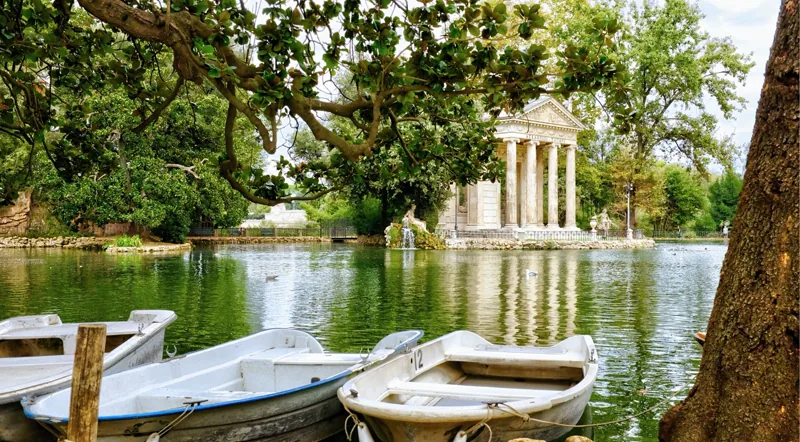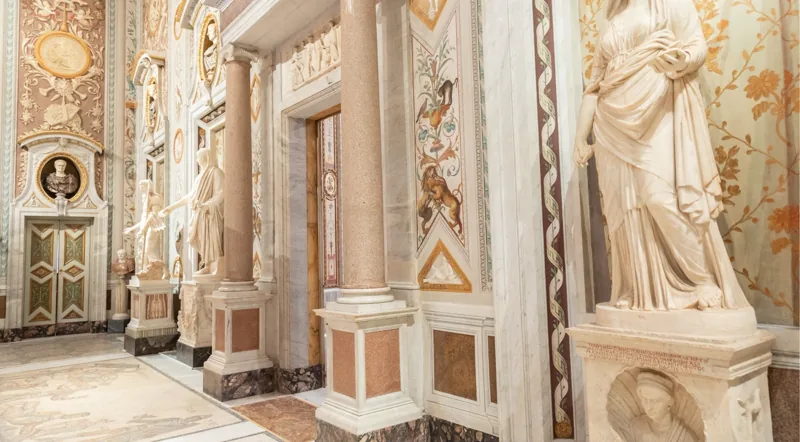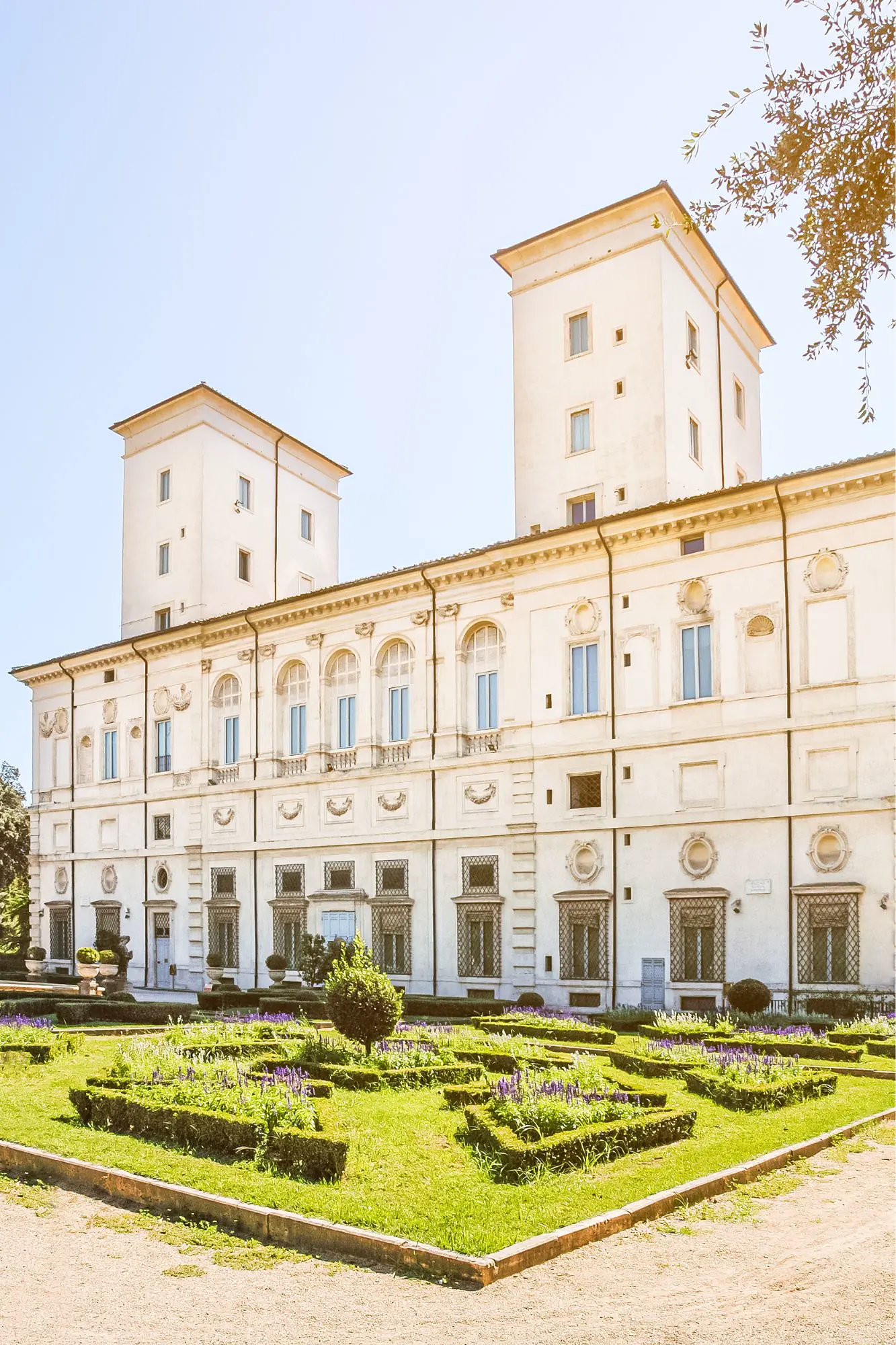
Piazza del Popolo is Rome's monumental entrance from the north: an immense oval with the city's oldest Egyptian obelisk at its centre, two apparently identical churches framing it, and three streets fanning out towards the heart of the historic centre. Inside the basilica of Santa Maria del Popolo, a few steps from the gate, the Cerasi Chapel holds two Caravaggios — the Conversion of Saint Paul and the Crucifixion of Saint Peter — free to see. From the eastern side of the square, the Valadier ramps climb to the Pincio in ten minutes, and to the Borghese Gallery in fifteen to twenty.
Where it is and how to get there
Piazza del Popolo sits at the northern end of the historic centre, at the foot of the Pincio, which is the western edge of the Villa Borghese park. This is where the Via Flaminia entered the city through the Aurelian Walls, and it is why the square served for centuries as Rome's front door for anyone coming from the north.
- Metro: Flaminio (line A), about three minutes on foot.
- Tram and bus: tram 2 and numerous bus routes serve Piazzale Flaminio, just outside the gate.
- On foot: from Piazza di Spagna along Via del Babuino, about ten minutes; from the Pantheon or Piazza Navona up Via del Corso, twenty to twenty-five minutes.
The square is flat, pedestrianised and fully accessible: the difficulties only begin if you decide to climb to the Pincio, as explained further down.
Other experiences in Rome worth adding
Stop at Piazza del Popolo and you are already inside Rome's densest quarter: from here you can walk to Piazza di Spagna and the Spanish Steps, to the Ara Pacis along Via di Ripetta and, in about twenty minutes down Via del Corso, to the Pantheon and Piazza Navona. Climb the Pincio ramps instead and you enter the gardens of Villa Borghese and reach the Borghese Gallery. Many visitors pair the basilica with a Caravaggio in Rome itinerary, or with a guided tour on Bernini and the Roman Baroque.
The square: what to see
Why it is called "del Popolo"
There is no single answer, and the authoritative sources simply record the theories. The three most credited: from the Latin populus, meaning poplar, for the grove that tradition says grew here; from the Roman people who funded the building of the church; or from the people as a community that gathered here for feasts and ceremonies. None prevails over the others.
The Porta del Popolo
This is the ancient Porta Flaminia of the Aurelian Walls, at the mouth of the Via Flaminia. It has two faces, built almost a century apart and by two great names.
The outer façade, the one that greeted arrivals, was built between 1562 and 1565 by Nanni di Baccio Bigio for Pius IV, taking the Arch of Titus as its model and reusing four columns from the old St Peter's basilica. It is often said the design was Michelangelo's, by then an old man: the question is disputed and sources differ on how much of the idea was his and how much his executant's. The statues of Saints Peter and Paul were added in 1638.
The inner façade is by Gian Lorenzo Bernini, made in 1655 for the ceremonial entry into Rome of Queen Christina of Sweden, who had abdicated her throne and converted to Catholicism. Above the archway you can still read the inscription commissioned for the occasion: Felici faustoque ingressui — "for a happy and auspicious entry".
The Flaminio obelisk
It is the oldest Egyptian obelisk in Rome and the first brought to the city. It was carved for the pharaoh Seti I and completed by his son Ramesses II in the 13th century BC, at Heliopolis, where it was dedicated to the cult of the Sun.
Augustus had it shipped to Rome after the conquest of Egypt, around 10 BC, and set it on the spine of the Circus Maximus. Toppled and broken over the centuries, it was rediscovered and re-erected here in 1589 by Domenico Fontana for Sixtus V. It stands about twenty-five metres, rising to more than thirty-six counting the base and the cross. The four Egyptian-style lions around it, with their stepped basins, were added by Valadier in 1823.
The twin churches
Santa Maria in Montesanto and Santa Maria dei Miracoli act as scenic wings at the mouth of the three streets. They were commissioned by Alexander VII and built from 1662 to a design by Carlo Rainaldi, with input from Bernini and completion by Carlo Fontana.
They look identical, but they are not: the two plots were different widths, and to achieve perfect symmetry the architects played with the geometry of the domes. From a distance the eye does not notice.
| Church | Position | Plan | Dome |
|---|---|---|---|
| Santa Maria in Montesanto | On the left, looking towards the Corso | Elliptical | Twelve-sided |
| Santa Maria dei Miracoli | On the right | Circular | Octagonal |
Santa Maria in Montesanto is known as the "artists' church": the Artists' Mass has been celebrated there since 1953, a tradition still alive, and it is where the funerals of many figures from Italian cinema, theatre and entertainment are held.
Valadier's oval
The square's present appearance is the work of Giuseppe Valadier, who between 1811 and the 1820s transformed it from a trapezoidal space into a great neoclassical oval, closed by two hemicycles.
In the two hemicycles, the Fountain of the Goddess Roma on the Pincio side — with personifications of the Tiber and the Aniene and the Capitoline wolf — faces the Fountain of Neptune opposite, with its tritons. The sculptures are by Giovanni Ceccarini to Valadier's design. At the far ends stand sphinxes and statues of the Four Seasons. Valadier also designed the ramps climbing to the Pincio, turning the hill into an architectural backdrop.
The Trident
Three streets fan out from the square — Via del Corso in the middle, Via del Babuino towards Piazza di Spagna, Via di Ripetta towards the Tiber — all converging visually on the obelisk. This is the so-called Trident, one of the most imitated urban schemes in Europe.
A square with a dark past
Until 1826 Piazza del Popolo was a site of public executions, which drew enormous crowds. Charles Dickens described one in his Pictures from Italy. During Carnival, by contrast, the famous riderless horse races set off from here along the Corso. Today it hosts concerts, demonstrations and street performers.
Santa Maria del Popolo: Rome's most underrated church
From outside it is sober, almost anonymous next to the drama of the square. Inside it is one of the densest art spaces in the city: Caravaggio, Raphael, Bernini, Bramante, Pinturicchio, Sansovino, Annibale Carracci. All free.
The legend of Nero
Tradition holds that the church stands on the mausoleum of the Domitii Ahenobarbi, where — Suetonius reports — Nero was buried. The place was thought to be haunted: a tree inhabited by demons in the form of crows terrorised passers-by.
In 1099 Pope Paschal II, after three days of fasting and — so the legend says — an apparition of the Virgin, had the tree felled, the emperor's ashes burned and scattered in the Tiber, and a chapel raised on the spot. The scene is carved in a relief above the high altar.
How much of it is true? That the church stands on the site of the Domitii tomb is confirmed by institutional sources. The ghost story is legend, and should be told as such. A parallel and more prosaic explanation ties the foundation to thanksgiving for the liberation of Jerusalem, which happened in that same year of 1099, funded by the Roman people.
Five centuries in one building
The church was rebuilt between 1472 and 1477 under Sixtus IV della Rovere, in Renaissance forms attributed to Andrea Bregno: it is one of Rome's earliest Renaissance churches. In the early 16th century Bramante extended the choir with a shell-shaped apse. Between 1655 and 1661 Bernini reworked it in Baroque terms for Alexander VII.
The Cerasi Chapel and the two Caravaggios
It is the first chapel to the left of the high altar, and it contains one of the most extraordinary combinations in the history of art.
The patron was Tiberio Cerasi, treasurer general of the Apostolic Chamber, who bought the chapel in July 1600. The contract with Caravaggio is dated 24 September 1600 and called for two paintings on cypress panel, to be delivered within eight months. Cerasi died a few months later, in May 1601, and never saw the finished work.
The first versions are not the ones we see. Caravaggio painted an initial Conversion of Saul, now in a private collection, and a first Crucifixion that has been lost. Why were they replaced? The biographer Giovanni Baglione — an avowed rival of the painter — wrote that they "did not please the patron". Modern scholarship offers other explanations: the chapel, still under construction, turned out narrower than expected; or Caravaggio, having seen Carracci's altarpiece, wanted to rethink his own canvases in relation to it. The debate is open.
Conversion of Saint Paul. Saul lies on the ground, thrown backwards, arms flung open towards a light with no visible source. Christ does not appear. Three quarters of the scene is taken up by the horse, enormous, lifting a hoof delicately so as not to trample the fallen man, while an old groom holds it back. It is a religious painting whose visual protagonist is an animal: at the time it was a scandalous choice, and it remains disconcertingly modern.
Crucifixion of Saint Peter. Peter is being hoisted onto the cross upside down — as, tradition says, he asked, so as not to equal Christ. There is no glory, no landscape, no sky: only three men whose faces we never see, straining physically, with dirty feet and bent backs, to lift a weight. The cross cuts the canvas on a diagonal, and Peter's gaze turns upward, towards the altarpiece.
And in the middle, Carracci. On the altar, between the two Caravaggios, hangs the Assumption of the Virgin by Annibale Carracci — luminous, balanced, classical. It is the only place in the world where the two greatest painters of Rome in 1600 face each other side by side: shadowy naturalism against classicism. It is not an accident but a deliberate choice by the patron, and it makes this chapel one of the founding masterpieces of the seventeenth century.
The Chigi Chapel
Designed by Raphael around 1513 for the Sienese banker Agostino Chigi, with a mosaic dome showing God the Father among the Sun and the planets, and the pyramids marking the family tombs.
Left unfinished, it was completed by Bernini for Alexander VII between 1652 and 1656, with the statues of Daniel and the Lion and Habakkuk and the Angel: placed in diagonally opposite niches, they form a single scene that crosses the space of the chapel. It is the chapel made famous to a wide public by the novel Angels & Demons.
And there is more
- The frescoes by Pinturicchio in the Chapel of the Nativity and in the vault of the apse;
- the tombs carved by Andrea Sansovino in the choir, for Cardinals Ascanio Sforza and Girolamo Basso della Rovere, shaped as triumphal arches;
- the stained glass by Guillaume de Marcillat, among the first painted windows made in Rome;
- works by Sebastiano del Piombo, Carlo Maratta and Alessandro Algardi.
Practical information for your visit
- Free entry.
- Hours: the basilica keeps the usual midday closing of Roman churches, opening in the morning and again in the late afternoon, with reduced hours on Sundays. Visits are suspended during services. Check the parish's current hours before you go.
- Lighting: as in many Roman chapels, the light in the Cerasi Chapel is switched on by inserting a coin in the meter. Keep a few one-euro coins handy: in the dark the two Caravaggios are hard to see.
- Dress: shoulders and knees covered.
- The basilica was fully restored between 2022 and 2024 and reopened in December 2024, so it is in excellent condition today.
Caravaggio in Rome: where to see him
The two Cerasi Chapel paintings date from 1600–1601 and come immediately after the Saint Matthew cycle painted for the Contarelli Chapel: this is the moment when Caravaggio, barely past thirty, became the most talked-about painter in Rome.
Free, in the churches:
- Santa Maria del Popolo — Conversion of Saint Paul, Crucifixion of Saint Peter
- San Luigi dei Francesi — the three canvases of the Contarelli Chapel
- Sant'Agostino — Madonna of Loreto (Madonna of the Pilgrims)
With a ticket, in the museums:
- Borghese Gallery — the most important collection
- Palazzo Barberini, Galleria Doria Pamphilj, Capitoline Museums, Vatican Pinacoteca
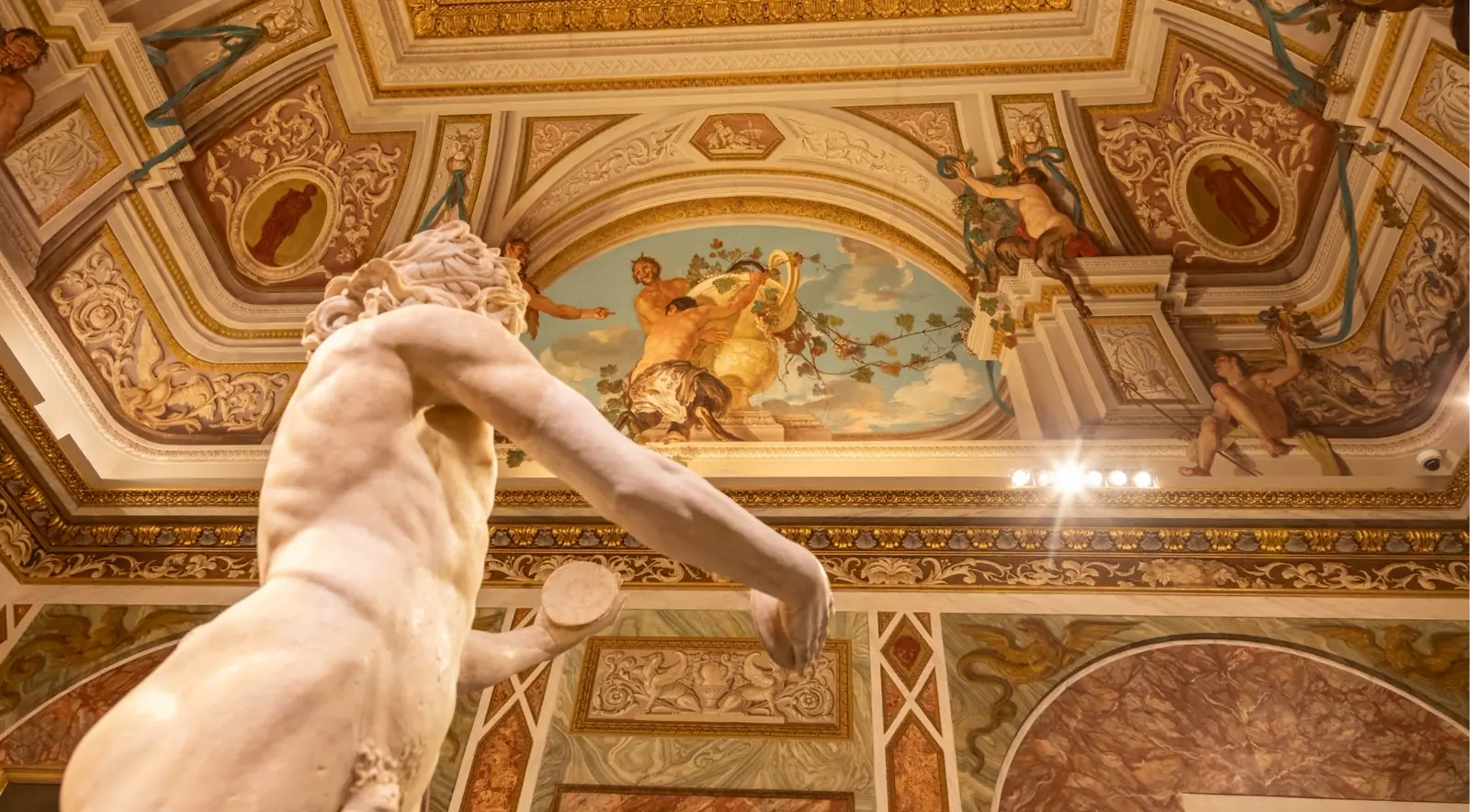
The Borghese Gallery deserves a mention of its own: it holds six paintings by Caravaggio, among them the Young Sick Bacchus, the Boy with a Basket of Fruit, the Madonna of the Palafrenieri, Saint John the Baptist and David with the Head of Goliath, in which the giant's severed head is a self-portrait of the painter. Cardinal Scipione Borghese, who also owned the villa, originally had even more. We cover them one by one in our guide to the six Borghese Caravaggios.
Seeing the Borghese Caravaggios with an art historian
After the Cerasi Chapel, Room VIII of the Borghese Gallery is the natural next step: six canvases spanning the whole arc of the master's career, from his beginnings to the last works painted on the run. A small-group guided tour helps you read them inside the strictly timed two-hour slot, without losing time working out where things are.
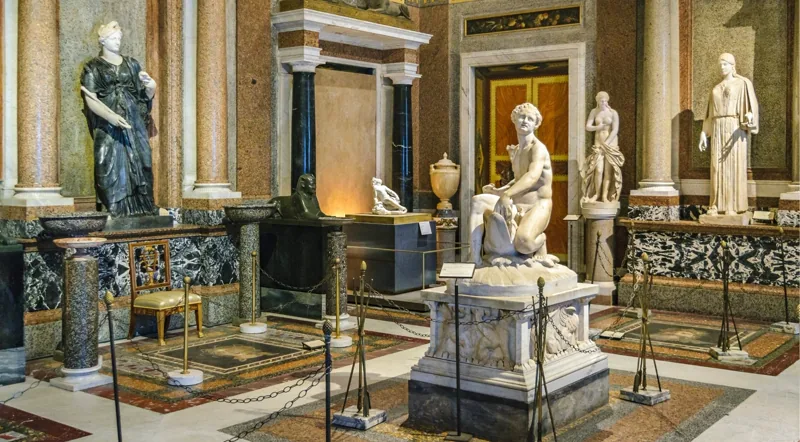
Small-group guided tour with skip-the-line entry
A licensed art historian walks you through the six Caravaggios of Room VIII, Bernini's marbles and Canova's Pauline, at the pace of the two-hour slot. It is the best-rated tour on this site: 4.7 from 2,700+ reviews.
From Piazza del Popolo to Villa Borghese and the Borghese Gallery
It is the finest and least known connection in the area: from the square you climb straight into the park.
The Valadier ramps start on the eastern side of the square, just before the basilica, and rise in switchbacks and staircases to the Pincio Terrace. The climb takes about ten minutes on foot, with some steps along the way. At the top the whole square opens up below you, with the dome of St Peter's behind it: at sunset it is one of the finest views in Rome.
From the terrace you continue into the avenues of Villa Borghese and reach the Borghese Gallery in a total of fifteen to twenty minutes from the square.
Accessibility: the square is flat, but the climb to the Pincio involves ramps and steps. There is also a lift on the Muro Torto side, though it is worth checking that it is working before relying on it.
Piazza del Popolo, Villa Borghese and the Borghese Gallery are three different things that only partly overlap: the square is public and always open, the Villa Borghese park is free, while the Borghese Gallery is a state museum with a ticket, compulsory booking and strictly limited two-hour slots. Turning up at the door without a reservation means not getting in.
If you want to do the climb and the visit in one go, the tour combining gallery and gardens is the format that best matches this itinerary: you cross the park and enter the museum in your booked slot.
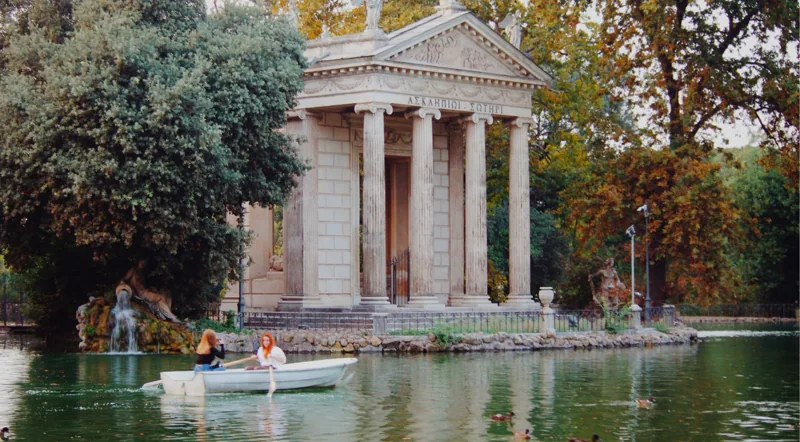
Borghese Gallery and gardens: small-group guided tour
Two and a half hours covering the villa's gardens and the museum's twenty rooms, with a small-group guide and entry in your booked slot. Rated 4.7 from 2,800+ reviews.
What's nearby
- Via del Corso — a kilometre and a half of shops down to Piazza Venezia.
- Via Margutta — the artists' street, with studios, galleries and wisteria-hung courtyards, just off the Babuino.
- Ara Pacis and the Mausoleum of Augustus — towards the Tiber, along Via di Ripetta.
- Piazza di Spagna and the Spanish Steps up to Trinità dei Monti — ten minutes on foot.
- The square's historic cafés — Rosati and Canova, facing each other, historic rivals and a haunt of writers, film directors and painters in the twentieth century. Both are still trading, at the prices you would expect from a table with that view.
On to the Borghese Gallery
If the two Caravaggios of the Cerasi Chapel have left you wanting more, the richest collection of them is twenty minutes' walk away, at the top of the Pincio. The Borghese Gallery does require booking, though: access is by limited timed slot and places sell out weeks ahead. For prices, slots and official channels, see our guide to Borghese Gallery tickets.
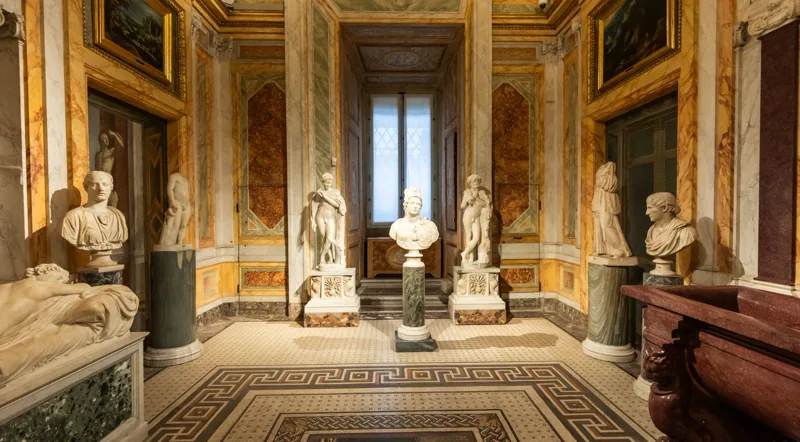
Ticket + audioguide or guided tour (optional)
The same entry in a booked slot, with the option to add — at checkout — an audioguide or a guided tour. It is the most flexible choice if you are arriving on foot from the square and don't yet know how long you'll want to spend inside. Rated 4.5 from 3,500+ reviews.
Frequently asked questions
Answers to the questions that come up most about Piazza del Popolo, the basilica and its Caravaggios.
Where is Piazza del Popolo?
At the northern edge of Rome's historic centre, at the foot of the Pincio hill, just inside the ancient Porta Flaminia. The nearest metro stop is Flaminio on line A, about three minutes away on foot.
Are there really Caravaggios at Piazza del Popolo?
Yes. Inside the basilica of Santa Maria del Popolo, which faces the square, the Cerasi Chapel holds two Caravaggio masterpieces: the Conversion of Saint Paul and the Crucifixion of Saint Peter, painted between 1600 and 1601.
Do you have to pay to see the Caravaggios in Santa Maria del Popolo?
No, entry to the basilica is free. It is worth carrying some coins, though: the chapel lighting is coin-operated, and in the dark the paintings are hard to make out.
What are the basilica's opening hours?
The church follows the traditional midday closing of Roman churches, opening in the morning and again in the late afternoon, with reduced hours on Sundays; visits are suspended during services. Check current hours before you go.
Why do the two churches on the square look identical?
Because they were designed to. The two plots were different widths, so the architects varied the geometry of the domes — one elliptical, one circular — producing an effect of perfect symmetry seen from the square.
How old is the obelisk?
It dates from the 13th century BC, carved for the pharaohs Seti I and Ramesses II. It is the oldest Egyptian obelisk in Rome: Augustus brought it to the city and it was placed in the square in 1589.
How do you get from Piazza del Popolo to Villa Borghese?
Up the Valadier ramps on the eastern side of the square: about ten minutes on foot to the Pincio Terrace, from which you enter the avenues of the Villa Borghese park. The Borghese Gallery is fifteen to twenty minutes away in total.
Are Piazza del Popolo and Villa Borghese the same thing?
No. Piazza del Popolo is a public square at the foot of the Pincio; Villa Borghese is the large park that stretches above it, and the Borghese Gallery is the museum inside that park.
How long do you need for the square?
Half an hour for the square itself, a good hour if you add the basilica, two hours if you also climb to the Pincio for the view.
When is the best time to visit?
Early morning if you want it quiet, sunset for the view from above: from the Pincio Terrace you see the whole square, with the dome of St Peter's behind it.